Full of good stuff for one of my works-in-progress.
http://motherboard.vice.com/read/how-humans-could-become-our-own-walking-hard-drives
Full of good stuff for one of my works-in-progress.
http://motherboard.vice.com/read/how-humans-could-become-our-own-walking-hard-drives
Via Larry Panozzo: a cunning plan to hack the nervous system in order to help chronic pain, PTSD and other issues.
Originally shared by Larry Panozzo
< >
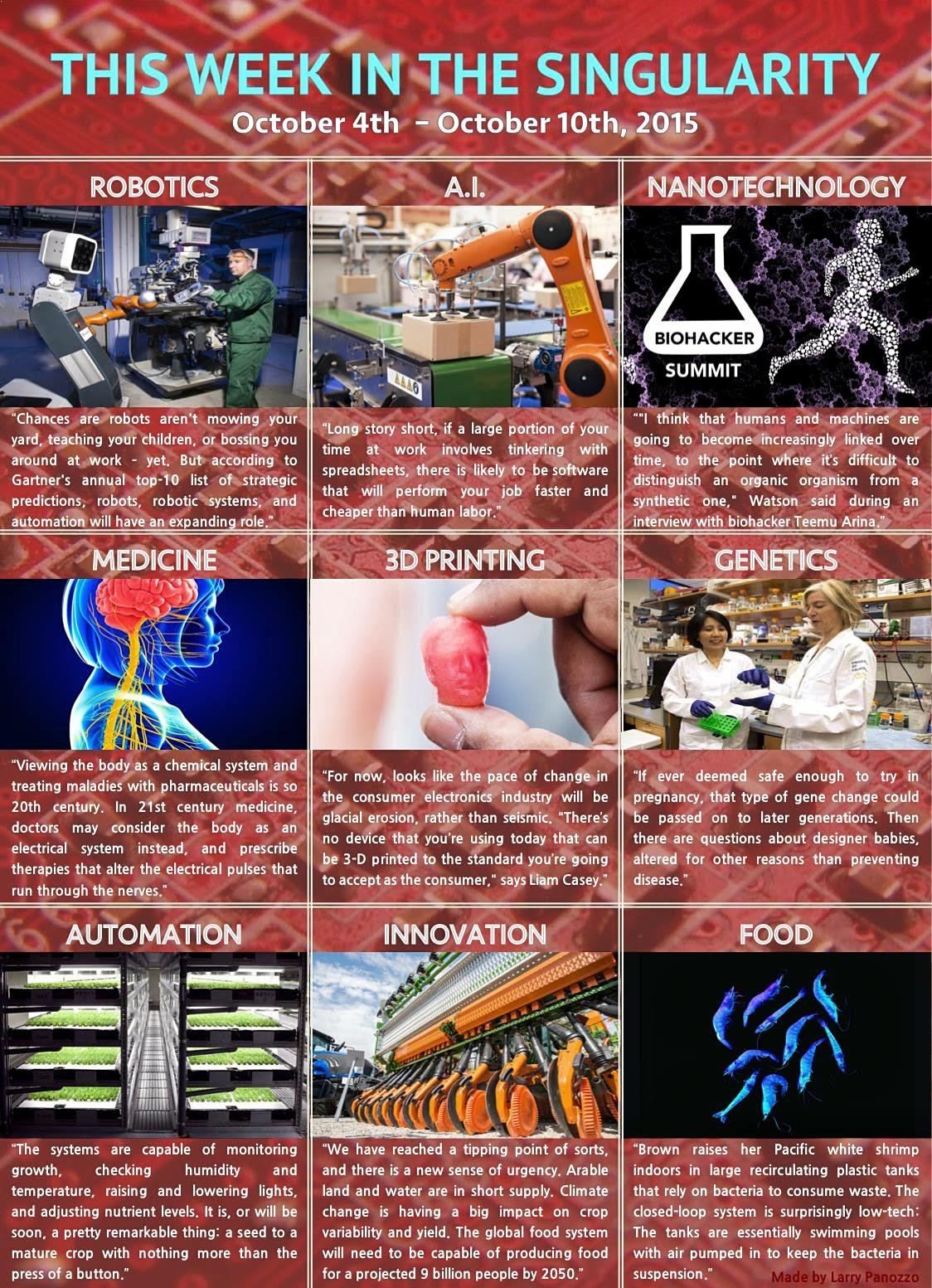
The singularity is near here! As usual, here are a few of the last week’s best articles from around the web illustrating humanity’s progress toward the singularity. Enjoy 🙂
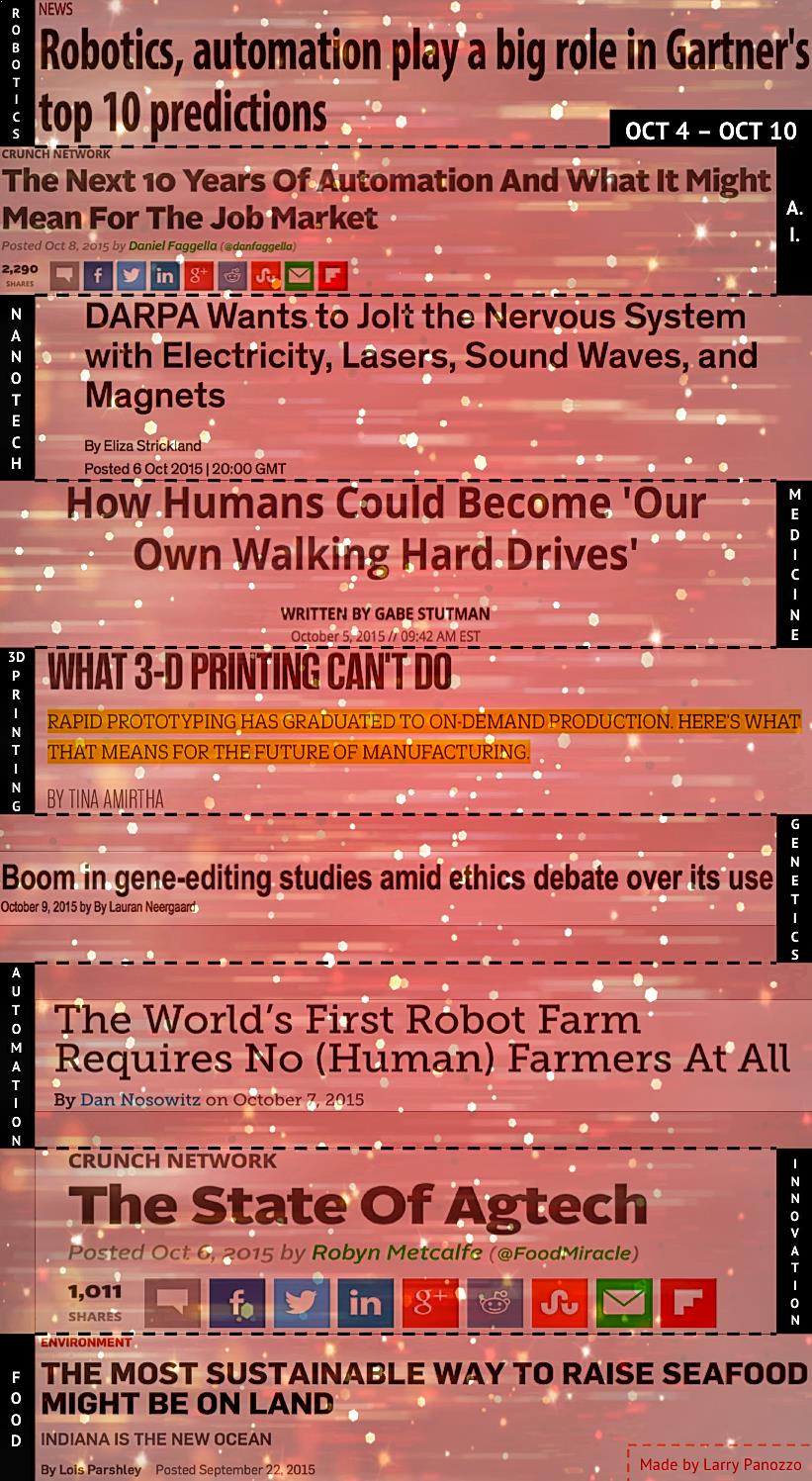
• ROBOTICS: http://www.computerworld.com/article/2989830/it-careers/machines-are-replacing-writers-gartner-says.html
• ARTIFICIAL INTELLIGENCE: http://techcrunch.com/2015/10/08/the-next-10-years-of-automation-and-what-it-might-mean-for-the-job-market/
• NANOTECHNOLOGY: http://motherboard.vice.com/read/how-humans-could-become-our-own-walking-hard-drives
• 3D PRINTING: http://www.fastcompany.com/3051175/tech-forecast/what-3-d-printing-cant-do
• GENETICS: http://phys.org/news/2015-10-gene-spurs-debate-ethics.html
• AUTOMATION: http://modernfarmer.com/2015/10/worlds-first-robot-farm/
• INNOVATION: http://techcrunch.com/2015/10/06/the-state-of-agtech-then-and-now/#.5e8nhj:iBSe
• FOOD: http://www.popsci.com/shrimp-farm-indiana-future-seafood-production
Like my posts? Add me for This Week in Tech, This Week in Science, This Week in The Singularity, and lots more each week. Or just follow my Collection The Singularity !
#singularity #robotics #ai #nanotechnology #medicine #3Dprinting #genetics #technology
We’re at a pivotal moment in history. Billions of years of biological evolution has culminated to an intelligent species of hominids that in their sudden industrial-digital revolution create machines that can take them places they can’t even imagine. And to think that they don’t even pay attention to the transformation as neural networks make their first major appearances, as AI enters each of the main fields of science, and breakthroughs in computing threaten to leave even Moore’s Law in the dust. So do as I do and spread the word!
Wonder why I say the singularity is here? No it hasn’t literally begun, but the process directly leading to it is already underway. When I saw this little chart here http://28oa9i1t08037ue3m1l0i861.wpengine.netdna-cdn.com/wp-content/uploads/2015/01/Edge1.png I realized it was fair to say we’ve arrived, and it’s about to begin.
Whether or not this is your first time hearing of the singularity, check out this post by Tim Urban http://waitbutwhy.com/2015/01/artificial-intelligence-revolution-1.html
And read about what it actually is here http://en.wikipedia.org/wiki/Technological_singularity
Three and a half thousand words on a new story, “Leaving Our Town,” and another thousand on “Brother Blue”. I think that makes a good point to take a break and look for reprint markets for some stories for which the rights have reverted.
So I have a mid-future SF setting on simmer where technology has become a lot “softer” (read: more organic, in the background, largely unnoticed). As part of that, I’d like to have a mesh network of genetically-engineered microbes exchanging P2P wifi signals. They’re in plants, animals, people, and so the Net is everywhere.
My problem is, what stops these microbes evolving back into non-wifi-enabled microbes that would have an advantage over the wifi-enabled ones (because they wouldn’t be using energy to broadcast radio signals, and would get to use it for themselves)? What advantage is there to a microbe in being part of a mesh network?
Lacerant Plainer, Peter Smalley: any thoughts?
Looks like I’ve sold another story that I’d given up on. This particular market has had it since November last year, and never responded to my 90-day query in February, but I couldn’t think of another market to submit it to, so I let it sit.
Today they contacted me to say they thought they’d bought it, but had just realised that they hadn’t. (Their internal systems have been kind of a train wreck, by all indications.)
I was looking for a good summary of the Milford Method of writing critique, and I can’t imagine anything better than this.
Interesting.
Originally shared by Brie “Beau” Sheldon
http://qz.com/474671/move-over-shakespeare-teen-girls-are-the-real-language-disruptors/
If you write “literary” stories that are also genre stories, here are some markets to consider.
I’m seriously considering doing the Ray Bradbury Challenge: write a story every week for a year, and submit them for publication.
Bradbury claimed that it was impossible to write 52 bad stories in a row. I’m sure it is possible, but it would be hard.
There’s another part to the Bradbury Challenge, which is to read a short story, a poem, and an essay every night for 1000 nights. Not sure if I’m up for that part, though I can see how it would help.
Originally shared by Karen Woodward
Write 1 Sub 1:
“Here’s the challenge, should you choose to accept it:
“Write and submit a short story or poem every week (or month), starting the first week of January and ending the last week of December.
“Goal: 52 new submissions in 52 weeks (or 12 in 12 months).
“You don’t have to write and submit the same story within the same week — although that’s what Bradbury did. Often it pays to set a story aside for a while and come back to it.
“The length of your story can be as short as Twitter fiction (140 characters) or as long as a novelette (15,000 words). Any style, any genre: whatever you write.
“Every week, we post a “check-in” where you can tell the world about your progress. Share your triumphs and disasters — we’re all in this together.
“Ray Bradbury is reported to have finished a story each week, mailed it out to a magazine, then got to work right away on his next story. We’re going to spend this year in his shadow.
“Up to the challenge?”
I just discovered this site. What a useful, productive, idea!
