Feb 18

Why AI Slop Should Make You a Reviewer

This is a follow-up to my previous post, AI Slop: A Perspective. Both of them are mostly me thinking aloud about the issues. I’m not an expert on AI (though I have a close friend who is, and who has helped me considerably with both technical advice and personal perspectives). I do know a decent amount about novels, having read and reviewed more than a thousand of them just since 2014, when I started reviewing everything I read, and I’ve published sixteen of my own and spent a good deal of time thinking about the craft of creating them.

This post is one novelist and reviewer’s take on the current state of AI as at February 2026, especially as it applies to the idea of using AI to write novels (or create art in general), and ends with a realistic suggestion of what you personally might do about it all. It’s a field which is constantly and rapidly changing, and even if I present insights that are true today, they may not continue to be true. 

AI and Me

Let’s start with some background on my current use of AI, which is minimal, and why I don’t use it more. 

I use AI at work sometimes (my day job is in technology), almost entirely to save time when I’m trying to figure out what mistake I’ve made in some code or an Excel formula. I’ve never used it to write, and don’t intend to, but I have used it for cover art once, on my most recently published novel. I made that decision because I knew I wasn’t going to sell many copies, and the guy who usually does my covers charges several hundred US dollars that I knew I wouldn’t get back in the near future, if at all. To be clear, his covers are great, and he absolutely charges a fair price for them, but I couldn’t justify spending that money in that specific instance.

I’ve never felt happy about that decision, and in future I plan to go back to what I’ve done previously for projects that I expect to not be profitable: using GIMP and royalty-free source images. I will probably replace that AI cover when I have time to do so, as well. 

I’ve thought about using AI to do the part I don’t enjoy, which is the marketing, but I wouldn’t trust an AI agent with an advertising budget, and there are three reasons I don’t do marketing: because I don’t enjoy it, because I’m bad at it, and because I don’t like the way I have to pay Amazon now to get them to promote my books to people who would enjoy it. I’m stubborn that way, and since I have a day job and don’t have to make a living out of my writing, or indeed any money at all, I can afford to stand on principle and sell fewer books as a result. Other people are not so fortunate, and have to work with the market they have, not the market they wish they had. 

So why am I not using AI? My concerns are these: 

  1. Environmental impact. The nature of how AI works means it needs large datacentres that need a lot of power and then a lot of cooling as the chips heat up, to prevent them from melting themselves down, and both of these things have an environmental impact. This, of all times, is not the moment to be having that! This by itself should mean we don’t support the widespread use of AI!

    AI datacentres, specifically, use a lot of power and water, for technical reasons to do with the amount of computing power being applied. I’m told that an AI query uses about three times the energy of a Google search query.

    Sure, maybe fusion power is coming (it has been for decades, though it’s seeming closer than ever to actually happening), but even if you’re generating effectively unlimited power cheaply and cleanly – and, as yet, we’re not – the waste heat still has to go somewhere, and you still need a lot of water to do the cooling, and clean water is a scarce resource that actual people need in order to live, and that is made into not-clean water (and often evaporated entirely) by the cooling process. Yes, you could power the datacentres with renewables, which have no net heat effect, since the generation takes heat out of the environment in order to turn it into power. Yes, you could heat homes with the waste heat; it’s being done in Scandinavia. Yes, you could recycle the water, though it makes the cooling more costly. There are mitigations that can be put in place. But they’re mostly not in place yet, largely because most AI datacentres are in the US, where regulations don’t require the mitigations and the power generation mix includes a lot of fossil fuels still. This alone makes AI use ethically dubious unless there’s a significant upside that you can’t otherwise get in order to balance the downside. Sometimes there is, but I don’t think generating a cover for my book is one of those times. 
  2. Wholesale piracy of intellectual property. It’s quite likely that Meta’s AI has been trained on pirated copies of several of my books, along with thousands of others that they could certainly have afforded to pay for. I’m not going to go into the argument about how the collective creative output of humanity up until now is inherently the source for any new creativity, and therefore the AI trainers were engaging in “fair use” when they used copyright works; I don’t agree with it, but I’m not going to die on that hill. I do resent the outright piracy, though.
  3. I don’t trust big tech companies to behave ethically in any way unless it happens to coincide with what will get them the most profit, and I think their record bears me out here. Social media was honestly never great, and is now thoroughly awful thanks to profit-led decisions by the exact people who are developing AI, or people who are very like them. AI has the potential to be even more awful, and I don’t want to be locked into it when that happens.

    Anthropic does seem to be trying harder than the other companies not to be evil, but we saw how it went when Google announced that as a goal. And they’ve settled for over a billion dollars with some authors whose books they pirated.
  4. The development issue I mentioned in my earlier article – fewer people being willing to make things that AI could currently make better than them, in order to learn how to do it and eventually reach the point where they can make things that AI could never make. That’s a big problem for humanity, which is already affecting real people (junior developers, who are finding it hard to get work that would eventually turn them into senior developers, who in turn are, despite the hype of some AI moguls, still people we very much need). 

The Work of Art

But maybe a lot of people would never get good enough to make things an AI couldn’t make? Most people have average ability or close to it, after all. The thing is, in writing as in anything else, you level up by grinding, so even if you start out average, if you want to be above average and have any potential to be so, you will have to work at it. I linked in my last post to this video by Brandon Sanderson about the exact issue I’m discussing, in which he talks about how, as a young man, he wrote a novel that sucked, knowing it was going to suck, in order to have the experience of writing a novel and learn something from the process. He learned enough that his next novel sucked less. By the time he wrote his sixth novel, it hardly sucked at all, to the point that he was able to get that one published, and he’s gone on getting better since. This is because he thinks about his craft as a craft, and works hard to do it as well as he’s capable of. He’s now very good, and has made a lot of money doing it – which is not an inevitable outcome, nor is it necessarily mainly because he works so hard at his craft, though I’m sure that plays a role.

There will always be people who enjoy making art for the sake of the process, for the enjoyment of the craft, and that’s not going away. We’re now in the third century of the industrial era, in an age when anything you can imagine can be made by a machine, and plenty of people still make, and buy, handcrafts. 

Unfortunately, there’s not always a correlation between producing good art and enjoying the process; some good artists hate the process and find it incredibly painful, but go through it anyway because they’re driven to create or for some other reason, like it’s what they’re good at and can make a living doing. One of the fears about AI art is that some of them may not be able to make that living anymore, and then we lose them as artists. Is the gain of having all the AI artists instead worth it to us collectively? What about the impact it has on the humans who aren’t able to make a living making art anymore? What are they going to do instead? In some cases, something they struggle with less, but in other cases, something they struggle with more. And I think the latter will outweigh the former. 

This is far from the first time technology has caused this sort of transition, of course, and the world is somehow still functioning. A century ago, the introduction of recorded music as soundtracks for silent films took work away from a lot of musicians, including my grandmother, who played the piano for the silent movie theatre. She probably didn’t get well paid for it, but with two small boys and her husband employed as an engine driver, any extra would have been welcome. Then there’s the transition from artists grinding their own pigments to buying them from colourmen. I’m sure someone railed against that, but not every process has to be done by hand. Still, that’s not to dismiss genuine concerns about the transition that AI will bring; it will cause, has already caused, real harm to real people, whatever benefits it ends up having in the long term. 

There’s a Venn diagram of art, in which the set of art that shows good craft and the set of art that appeals to a wide audience overlap, but are not by any means identical. Brandon Sanderson’s novels, and a good many other people’s, are in the overlap, but there are ones that gain a wide audience and don’t have good craft (such as Twilight), and ones that have good craft and don’t gain a wide audience, like a lot of the heavier Russian novels, Kafka, or Finnegans Wake. There are various reasons why good art doesn’t get an audience, whether it’s because it’s ahead of its time, difficult, uncomfortable, or just for reasons of discoverability, of which more later. 
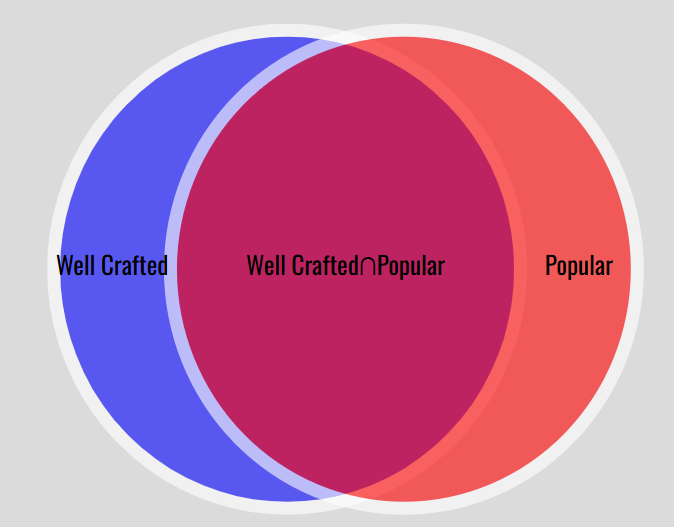
Let’s not, by the way, get into the gatekeeping discussion of what is and isn’t art, or at what point it’s so poorly crafted it isn’t art anymore. I’m calling it all art. 

So there’s a parallel discussion to be had about commercialism in art. There are people who are only producing art because they make money at it. There are people who would, perhaps do, pay to make art because they love the process and/or the product so much. But the art in the middle, that’s produced both because the artist wants to spend time making art and also because they can make some money out of it and so justify, or even just afford, spending that time not doing something else – that’s where the pinch comes if it’s cheap and easy to make poorly-crafted art, some of which is commercial and replaces the work of people who used to make art for a living. 

And there will always be people who, for the sake of making money, will produce something that they don’t care about by a process they also don’t care about, even a process that harms someone else. If that’s easy and has any chance of being profitable (in social capital or actual money, and these days on social media the two are linked), there will be a lot of such people, and most of them will inevitably do it badly. 

The Dunning-Kruger Effect applies, too: There are people who are bad at art and don’t know it, so they won’t improve. (If you do know you’re currently bad at it, you’re in Brandon Sanderson’s position when he was writing bad novels in order to learn and get better.) AI is an amplifier; if you’re bad at art, you can easily make more bad art than ever before, and you probably won’t even recognize it as bad. When I use the shorthand word “bad” here, I’m talking about the “poorly crafted” part of the Venn diagram above. In the case of fiction, I mean that they don’t know the basic mechanics of writing (like grammar, usage and punctuation); don’t understand the world we live in well enough to build a fictional one; don’t know how to create a plot without forcing it along through coincidence or out-of-character choices; can’t write believable or interesting or three-dimensional characters; or don’t express themselves clearly at a sentence level. All these are faults I see abundantly in books I review that are not produced with AI, even though I dodge a lot of worse ones by avoiding unoriginal premises and books with obvious errors in their blurbs. And most of these things, apart from basic mechanics, will not be helped by LLMs in their current state. (Pasting your book into Google Docs, which is free, and following the suggestions will improve your basic mechanics well past the standard I see in many recent books I’ve reviewed, by the way. The suggestions aren’t always correct, but they are often enough correct that on average, following them will improve your document. The spelling and grammar checker is, of course, an LLM.) Not expressing yourself clearly, in particular, is likely to give you an outcome you weren’t looking for if you use an LLM. 

Now, maybe a good artist could use AI to amplify their abilities too. Coders who are seeing the most gain are the ones with good engineering discipline, who are already used to using precise language (code) to make it clear what they want.

But see my concerns above, which hold me back from experimenting in that direction – even if the creative writing field of which I’m part didn’t have rules against using generative AI for things like short stories to be published in the major magazines. I could do it for my self-published novels, because honestly if people shun me for it I’ll hardly notice the difference, but, again – concerns. And even if those concerns didn’t exist, I don’t really see where the effort I would put in learning to use the tools would gain me anything I valued. I enjoy the process of writing; that’s largely why I do it. There aren’t parts of it I want done for me. I even enjoy the sanding.

Not to mention that, in the US at least, there is no copyright protection for AI-generated works. Copyright requires a human creator, and even if you have done part of the work, copyright legally only applies to the part you did.

I have thought about converting my book The Well-Presented Manuscript, and the various craft posts I have here on my blog, into an AI tutor or coach for human writers, to help them get better quicker. It’s all my own IP, after all, and I can do what I want with it. But my other concerns about AI are too strong; it would directly compete with human editors; and besides, I don’t have the time. Building a tool like that is very time-consuming, contrary to the popular conception of how easy it is to create useful things with AI.

I don’t know if that will continue to be my position. Maybe I will try it someday; maybe my concerns will be mitigated, or there’ll be a use case that’s compelling enough for me to overcome them. 

In the meantime, don’t expect me to talk a whole lot more about AI after this post, because as someone who deliberately doesn’t use it I’m in no position to talk about it from the inside. I can talk about art, and speculate on AI’s impact on art, but the technology itself is something I’m not an expert on, and can’t become an expert on without immersing myself in it. I will be using more AI at work this year, mostly in the form of machine learning rather than LLMs, and if I learn anything I think is relevant to writing, I may post about it. We’ll see. 

Slop-pocalypse?

So, the ease of making AI art could lead to a slop-pocalypse (more than there is already), though there are limitations on AI that may temper this problem. Most importantly, much of the real cost of operating these machines is currently being borne by venture capitalists in the hope of an eventual payoff, even though there’s no obvious business model; when the business model cuts in and it’s no longer cheap or free, that will drastically diminish the slop (while de-democritising the technology, so once again people who already have lots of resources will be able to do things that people who have fewer resources can’t). It will also, our experience with social media should have taught us, make AI utterly awful, and I think it has more potential to be awful even than social media, unless someone stops it. It’s pretty awful in places already; read up a bit about Grok if you aren’t already aware. My friend who I mentioned above is working on the governance side of AI, trying to be one of the people who stop it being awful, and I’m glad that’s happening, rather than just – as with social media – leaving it to people to sue after the harm has already been done. There are some very predictable harms that AI can produce and is, in some cases, already producing, and unless we collectively decide they’re not acceptable, we are going to have to live with them. 

On the other hand, “slop-pocalypse” is probably too alarmist. Every new technology, and art form, has been condemned when it appears. Socrates feared that writing would harm human memory. Prose fiction, largely written by women, looked like a terrible, civilisation-ending thing in an age used to epic poetry by men. Yes, there will be negative impacts of AI. No, it isn’t going to destroy human writing, or human creativity. We’ve had electronic instruments for years that mimic the sound of a real instrument near-perfectly. People still play real instruments. 

A few years ago, when indie fiction became a thing, the term “tsunami of crap” was bandied about a lot by people who feared that it would mean the end of publishing. And it did make discoverability harder, and there is a lot more bad writing available now. At least some of it sells, too, because, as I’ve noted, there is a difference between executing something well in a craft sense and making that something somehow appealing to consumers; this difference exists throughout the market, in traditional as well as indie publishing, of course. Ninety percent of everything is crap, and “everything” definitely includes traditional publishing, though the exact percentage may vary locally. What the so-called “tsunami of crap” didn’t mean was that there was no good indie writing produced, or no good writing produced at all. But it does make it harder to find, and so does the slop-pocalypse (so called). 

So if discoverability is a problem, we owe it to each other to help discover good stuff – that’s partly why I review. Review books you like, especially obscure ones! Follow people who review things you like so you can find other things you like! 

Of course, you’ll need to watch out for AI reviewers. I got five friend requests in a single day on my Goodreads profile recently, which is unusual, and when I looked at them, all five had profile pictures that had clearly been generated the same way, several of them were “friends” of each other, and they’d all reviewed the same three books, including one that I’d reviewed – hence, presumably, the friend request, to make them look more legit. The reviews all had that hard-to-define but easy-to-recognise smell of LLM. I reported them as review-farming bots, naturally. 

But… find someone you’re confident is a person, follow their reviews, and get the books they recommend that sound like your thing. And then review them for someone else to find. We humans need to stick together. 

Feb 02

AI Slop: A Perspective

Warning: some of this is going to sound a lot like snobbery, and maybe it is. A couple of people have told me it isn’t, that it’s insight built up from years of writing and reviewing. Judge for yourself.

About 10 years ago, I read about an elderly woman on what was then Twitter who spent her days posting and reposting huge volumes of material in support of her favoured political candidate (doesn’t matter who that was, not the point). Twitter’s automatic moderation kept banning her as a bot.

I remember thinking at the time, “Well, isn’t she a bot? A bot implemented in the form of an elderly lady, sure, rather than as software, but she’s acting exactly like a bot. The auto-moderation is right to treat her as one.”

I’m reminded of that because I’ve been thinking about the coming impact of AI on the creative arts.

I recently read a piece on The Conversation about how, if you feed a large language model (LLM) a prompt and then get it to alternate between turning text into images and images into text for a few iterations, you will quickly get bland, generic, meaningless images without any relationship to the original prompt.

This isn’t surprising. After all, LLMs are not actually intelligent, artificially or otherwise. They’re basically sophisticated autocorrect. They’re trained to predict what most probably comes next, or the most likely response to a prompt. Of course they’re going to produce something bland and expected. That’s what they’re built to do.

(My friend who knows a great deal more about AI than I do says this is so much of an oversimplification that it almost isn’t true, and also the study is flawed if you think about it even a little bit. I’ll write a follow-up when I get time, discussing this. But the main point here is that LLMs have at least a tendency to return expected content, and anything stronger than that statement is not essential to the following discussion.)

Which is potentially bad news (or… is it?) for the people who have, for a few years now, been producing bland, expected fiction “written to market” – in other words, written to be similar to already existing properties that are successful. And also for Hollywood, which is producing a parade of increasingly bland, formulaic remakes and sequels. I don’t listen to current music, but I’m informed it’s going through the same blandification process, thus perfectly setting up for LLMs to come in and take over. (I don’t think this is the result of a conspiracy, to be clear.)

And the thing is, LLMs are often very good at doing this kind of thing. And they can punctuate a lot better than most of the people who are churning out fiction rapidly from box mix and selling it to people who want the same thing over and over again. I sometimes refer to this as “extruded fiction product” or, if it’s done less completely formulaically, “If you like this sort of thing, this is definitely one.” Just as the elderly lady was acting like a bot, these people have been acting like LLMs, meaning that it’s potentially easy for LLMs to do what they do.

Though, having said that, it’s also emerging from research into the use of LLMs in software development that the people who are getting the most gains are the people who have the best engineering discipline in the first place, who are using the LLM for the tedious parts and carefully checking its output. So perhaps we can’t dodge that work after all – or, if we do, we need to be aware that the outcome won’t be great. But the people I’m mostly talking about are the people who already didn’t care much about quality, who put a higher value on velocity. They will now be able to produce more low-quality fiction (or code, or visual art, or video) than ever before. I haven’t been on Facebook for years, happily, but I’m told it’s already overrun with low-quality, low-effort AI images, which the platform doesn’t do much to discourage because they get “engagement”. I have to believe that if people buy crappy LLM-produced fiction on Amazon, Amazon isn’t going to try very hard to stop them.

On the flip side, a recent study reports that, while on a standard test of “linguistic creativity” LLMs do better than the average human, they do significantly worse than the average of the top 50% of humans, and the gap widens if you look at the top 25% or top 10%. Even if you turn up the randomness in the model to its maximum, so that it’s producing less “expected” outputs, more than 25% of humans still score above the LLM. Yes, the models will continue to improve, but I believe there’s an upper bound just by the nature of what an LLM is – and you rapidly hit a law of diminishing returns as you push towards larger models that take more factors into account or can retain a longer window of context, such as you would need in a novel. LLMs can’t write whole novel-length books yet, not coherently at least, and perhaps will never be able to, barring some advancement in computing that’s beyond our current prediction horizon. (What they can do is produce 95% of some of the copyrighted work they’ve been trained on, verbatim, which, in at least the case of Meta’s AI, incudes some of my books, via a pirate site. More on that in a future post, but that would certainly make it easier to produce new versions of those same books with a few names changed.)

Also, increased randomness doesn’t necessarily produce what humans would rate as better outputs, just more unusual ones. Top human creatives not only have the skill to generate unexpected ideas, they also have the skill to distinguish a ridiculous idea from one with potential to be great. Not to mention that they have a depth of insight into humanity that is part of what lifts their creative works above the ordinary.

Over the past couple of years, I’ve been reading a lot of old fiction from Project Gutenberg, in part because it’s hard for me to find enough fiction being produced today that isn’t bland and generic, and I’ve discovered something that will probably not surprise you even a little bit. A lot of the fiction being produced in, say, the 1920s was pretty much alike, shallow, conventional, and not very well written. The enduring classics, the ones that are still widely read today, that are reprinted (often with minimal editing from a bad scan) by major publishers, are the exceptions, the ones that were doing something different, something original, something inimitable.

So, while I have all kinds of concerns about AI (more on this in an upcoming article), I do have a form of hope, and it’s this. I hope that we’ll start to see a divide develop. On the one hand will be the people who are now using AI to do what they used to do themselves – produce bland, cloney books that are almost indistinguishable from each other to feed a particular appetite in the market for something recognisable and unchallenging. I suspect the quality may even rise a bit, though the coherence may drop. And on the other hand will be people who are exercising human creativity that can’t be imitated by an algorithm that seeks to predict what’s most likely to come next.

The key thing will be how easy it will be to distinguish the two in the market. If there’s a “not made with AI” label of some kind that people can use (which itself will be fraught with controversy as people inevitably try to game it), the divide will be more obvious, and people will be more easily able to buy the kind of fiction they prefer. Most will prefer the expected kind, because that’s always been the case since cheap fiction became technologically possible. But some will prefer the unexpected kind, and they will potentially have a discovery problem, of which more in my promised follow-up.

I suspect they’re the ones who are already ignoring the dozens of similar books about, for example, a young (or middle-aged) woman who returns to the small town where she grew up to deal with an inheritance, discovers she has a connection to the supernatural, gets improbably accused of a crime, and works to solve it along with her cute, chatty familiar, her completely subservient best friend and the hot guy who’s a police officer and/or werewolf.

It is possible to write even that story in a fresh way – I’ve seen it done (by Tim Pratt in Heirs of Grace – link is to my review). Not many people can do it, though. An LLM can’t do it and, by the nature of LLMs, probably won’t ever be able to. It can only write something close to the expected version, because that’s what an LLM is.

Now, there is another problem inherent here, and it’s the problem of development. In order to get good at any skill, you have to go through a period where you’re not good at it, and I suspect that if an LLM is better than the average person at many skills (programming, visual art, writing), a lot of people will never bother to go through that period of learning for those skills. They won’t see the point in producing work that, to begin with, will be worse than what the LLM could do.

Which means they will never get better than the LLM. And we need people who are better at those things than an LLM can ever be.

Still and all, I’m not very good at making physical things. In fact, I’m notably bad at some aspects of it. That doesn’t stop me from trying, when there’s a specific thing I can’t just order, or when someone is going to charge me ten times what the materials cost to do, yes, a better job, but not a ten-times-better job, or when I just want to explore an idea that nobody else seems to have had. And in an age of manufacturing now several centuries old, there are still plenty of people who enjoy the process of making things by hand for its own sake, and people who will buy those things at a premium because they’re made by somebody rather than something.

People who are going to be the truly great programmers, artists or writers are going to persevere through the period of not being good at it because they have a vision of being better than average, and maybe even because they enjoy the process itself, and they may even start out at a higher level than the starting point for most people. Meanwhile, the people who were never going to be very good at those skills have access to a tool that can help them be better, just like my power saw helps me make more accurate cuts more easily than I could make them by hand.

There will potentially be losses in the middle – the people who don’t persevere to get as good as they could be, and the people who were always going to be average or no more than a little bit above it, whatever their ambitions. They will eventually be forced out of the market by people who have no ambition to be more than average and are willing to crank a handle in order to make a few dollars, because they never had any particular love of either the process or the product for its own sake. I’m certainly not saying that the impact of LLMs on creativity is going to be an unmixed benefit, and maybe it won’t be much of a benefit at all. Perhaps it will be an overall detriment.

But it isn’t going to bring human creativity to a halt, any more than the much-lamented “tsunami of crap” of the early self-publishing era meant that there were no good self-published books. After all, 90% of everything is crap; Sturgeon’s Law is universal, at least wherever humans are involved (even if only as toolbuilders). But there is still that other 10%, and it’s not going away.

(Brandon Sanderson has a great video which makes some of the same points as I make above, some that are in contrast and some that go beyond what I’ve said. In particular, he expands on the idea of the worth of the process, not only for the art but also, crucially, for the artist. He’s also one of the examples I point to when I talk about someone who’s creating something exceptional in part by not doing what’s expected. And as he explains in the video, he got to that point by being willing to write something that sucked, and learning from that so that the next thing sucked less, and eventually reaching the point where his sixth thing didn’t suck much at all and was publishable.)

Mar 24

Well-Presented Manuscript Fourth Edition

I’ve just published the fourth edition of my nonfiction book for writers, The Well-Presented Manuscript: Just What You Need to Know to Make Your Fiction Look Professional. I’ve added some material, as I have in each new edition (it’s now twice the size of the first edition, but still the same price). The big change, though, is a complete restructure around the ten most common types of errors I see authors making in the books I review:

  1. Vocabulary. Now almost 200 entries on pairs, trios, or single words that are easily confused with each other or used incorrectly.
  2. Apostrophe usage. Two simple rules will enable you to get the apostrophe in the right place every time.
  3. Narrative tense. How to stop jerking your readers around in time so they have a smooth reading experience. Revised and expanded.
  4. Commas of identity (vocative and appositive commas). How to fix one of the easiest ways to spot amateurish writing.
  5. Commas of sequence (coordinate commas and lists). How to avoid an error that even some good writers still make. Revised and expanded.
  6. Commas of grammatical structure (phrasal commas). How to know where—and where not—to put a comma, without having to guess.
  7. Capitalization, hyphenation and other punctuation marks. Many different errors described and corrected.
  8. Dialog punctuation. A persistent problem for a minority of writers, with a few easy rules.
  9. Clarity of reference (number agreement, pronoun errors, dangling modifiers). Make sure your readers understand exactly what you’re talking about without having to stop and work it out. Revised and expanded.
  10. Research and knowledge. Common slip-ups that are easily corrected. Revised and expanded, including an extensive guide to differences between British and American English for authors who speak one, but whose characters speak the other.

At the back of the book is a simple reference for grammatical terminology and concepts, and a resource section for further reading.

Everything is still directed at improving the working fiction writer’s grasp of mechanics and usage, so that your prose reads smoothly and your readers can immerse themselves in your story.

For the first time, the book is available as a print volume as well as an ebook, but it should be available wherever you get your ebooks, including all the major stores and many libraries.

Mar 14

Arcs, Incidents and Vibe

One possible way of thinking about the different elements of story is that those elements include arcs, incidents, and something I’m calling “vibe”: the feel, mood, or tone of the story.

All stories have all of these, though some stories have a lot of one and very little of the others. And different readers have different preferences for the mix of these elements.

Incidents

I’ll start with incidents, since they are the smallest unit, in terms of the number of words used to convey them. A short story can be just an incident (though it’s usually stronger if it includes at least some element of arc and/or vibe).

An incident is one significant thing that happens. It can be a fight, a conversation, a discovery, an escape, a chase, a realization… An effective way to structure your scenes is to make sure that there’s at least one incident in each scene. If your scene doesn’t contain an incident, unless you are writing a very vibey book and the scene is there solely to build the vibe (and does so effectively), that’s probably a scene you don’t need.

An incident can (I’d almost, but not quite, say should) be interesting and enjoyable to the reader in itself. Stories that are strong in incident typically include adventure, suspense, mystery and thriller, but you can have a strong incident that’s a conversation or even just a character reflecting on their life and coming to a conclusion, if your writing chops are good enough. And there are genres–“cosy” fantasy, for example–in which mundane incidents are expected and welcomed; it can be enjoyable to see characters we like or identify with living their daily lives, though again, it takes some skill to achieve this.

Key to incidents, I believe, is that the reader should feel something while reading them. An incident with no emotional significance is just an occurrence. This is why I define an incident as “one significant thing that happens”. The character and the reader both care about the outcome. Mundane incidents that just fill space, like the notorious “morning routine” beginning to a story, generally need to be cut; you can write them to get momentum and feel your way into the character and setting, but you may want to go back and edit them down to a minimum afterwards, because neither your character nor your reader particularly cares.

The books I read as a child and young teenager tended to have a lot of incidents as their main strength, because it’s easy to be engaged by a well-written incident and imagine yourself in the situation. Especially for a young audience, arcs can be a bit rudimentary and, as long as your incidents are strong, you’re still OK.

Speaking of which:

Arcs

There are two main types of arc: the plot arc and the character arc.

Arcs include a number of incidents, which together make more than the sum of their parts. A series of discoveries that gradually reveals something that happened makes a mystery arc. A series of encounters where two people draw (on average) closer makes a romance arc. As the name “arc” implies, these aren’t just any random sequence of incidents; they form a shape, and take things from a beginning state to a different end state. If what is changing relates to a character (their circumstances, their understanding of themselves and the world, what they want, their relationship with others), that’s a character arc; if a broader situation affecting multiple people or the state of the world is changing, it’s a plot arc. You can think of them as inner and outer arcs, if you prefer.

Plot and character arcs are typically intertwined, and ideally your incidents are progressing both at the same time. But it’s possible to write a character who has no arc (Sherlock Holmes is a classic example) and still have a compelling and successful story based on your plot arc alone. And, of course, vice versa; plenty of literary novels succeed despite having very little in the way of external incident at all, because their focus is on the character arc.

Just as an incident has an emotional component, so an arc, either a plot arc or a character arc, is also, ideally, an emotional arc. We start out feeling one way, we go through different emotions along the journey, and we end up feeling another way.

In a mystery, we start out puzzled, go through the triumphs of discovering clues and the setbacks of having our theories invalidated, and end up understanding what happened. In a romance, we start out with the protagonists not together, go through the triumphs when they get closer and the setbacks when they get further apart or when obstacles come up to their happiness, and end up with them together. Those are both emotional journeys of different kinds, and it’s up to the author to structure and sequence their incidents in such a way that the journey is both satisfying and convincing to the reader.

There are conventions to arcs, some of which don’t necessarily reflect how things happen in real life; if the author departs too much from the expected shape of an arc, people who consume a lot of fiction will feel something is off, and the more reflective among them will be able to articulate why. For example, I read a book recently which was clearly a YA post-apocalyptic dystopian, but the protagonists’ interactions with the people who were running the dystopia were mostly positive, and they acted as mentor figures, while the leader of the group who were setting out to overthrow the dystopian regime was clearly toxic, and an antagonist who threatened the protagonists. That set up a dissonance for me that made the book puzzling and unsatisfying, and it was all based on narrative expectation; we expect that, in a dystopia, the bad guys are the ones maintaining it and the good guys are the ones opposing it.

People also have different preferences for what emotions the arc includes. I’ve read many a review that expresses frustration with a whiny character who’s always complaining that the world is against her, even while being a Spoiled Protagonist who gets unearned victory handed to her on a regular basis. Yet other readers love those exact same books, perhaps because they can immerse themselves in the character and dream about what it would be like if their life, where they feel the world is against them, was such that they received the nice things they think they deserve without effort on their part. Mystery readers enjoy the feeling of solving a puzzle and the satisfaction of justice done; romance readers enjoy emotions that are warmer and less abstract than that.

More and more, I’m noticing that books I read which are weak in other ways–such as their mechanics (grammar, punctuation, sentence structure, word usage) or their worldbuilding–can still work for me to a degree if the arc is sound. In the case of the dystopian book I mentioned above, I experienced the opposite; the mechanics and worldbuilding were decent, but the arc didn’t work for me, and I didn’t enjoy it much as a result.

Vibe

Vibe is the most subtle of the elements I’m discussing, partly because–even more so than arcs–it’s the sum of many parts, many small decisions by the author. Choice of words, what’s focused on in descriptions, the choices the characters make, the type of incident that occurs, and, of course, the emotions felt by the protagonist and, through them, the reader, all contribute to vibe.

A romantic comedy and a dark fantasy have very different vibes. If you were a film director, you’d probably shoot the first with lots of movement and colour, on well-lit sets, and the second with longer, lingering shots, slower camera movement, desaturated colours and shadowy sets. (Or, if it was a gritty dark fantasy, sudden, jerky shots reflecting violent action.) The way the actors spoke, the clothes they wore, the music on the soundtrack, but also the stakes, the balance between talking and action, and the kind of setbacks and consequences that occurred would all contribute to the vibe as well.

It’s possible to write a book that’s largely focused on producing a particular vibe. The incidents may consist mostly of someone observing events rather than participating in them, there may be a lot of conversation, the main character (who’s perhaps not truly a protagonist, in that they aren’t striving for anything) is likely to spend a lot of time in self-reflection. This is the kind of book that a lot of people will find boring and slow-moving, because the incidents are subtle and not action-focused and spaced some distance apart by passages of description, and the arc is gradual, and the characters, often, don’t have any obvious goal; others, who enjoy this particular vibe, will love immersing themselves in it and feeling the same emotions for an extended period. The Titus Groan books, I believe, are primarily vibe books; so are books like The Goblin Emperor, although there is something of an arc there. A lot of “cosy” fantasies, in which the incidents are often mundane and of significance mainly to the characters, are heavily vibe-focused.

When an author attempts vibe and fails, I sometimes describe the book as having “not much plot per thousand words”. The failure mode of vibe is to write incidents which are not, in themselves, interesting and which also don’t effectively evoke emotion, just as the failure mode of incident is to write incidents which are perhaps spectacular in themselves but also don’t mean anything to anyone–like many Hollywood action movies. (Hence the famous advice: Don’t write action scenes; write dramatic scenes that require action to resolve.)

Summing Up

Incident, arc, and vibe have a complex relationship, which I feel like I’ve come to understand better by writing this post; hopefully you’ve come to understand it better by reading it.

Incident contributes to vibe by evoking emotion in the character and the reader. An incident can fail by being too minor and mundane to be inherently interesting, or by being too disconnected from any important stakes to have significance, or, worst of all, both. An incident succeeds when the character and the reader care about it, and they will care about it if it is important to an arc (plot or character) or vibe (evoking a mood) or both.

For an incident to matter to an arc, it needs to help or hinder the character in their story goal (plot arc), and/or push against the character’s weaknesses or display and develop their strengths (character arc). But the other contribution incidents make to arcs is by providing appropriate emotions that help to make the arc an arc, and not just a series of events. The most engaging arcs either slowly build a consistent vibe and then either escalate or reverse at the moment of crisis, or they swing the reader and the character back and forth between anticipating triumph and disaster, with an overall average movement in one direction or the other.

Pacing is partly about how the incidents are spaced (how many words we go through to get to the next one), but it’s also about how their emotional beats are ordered, alternated, escalated and de-escalated. Traditionally, we think about “rising action” and “falling action,” in which events build from a base level through gradual escalation to a crisis which reverses the emotional direction and de-escalates the suspense to a satisfying and relieving conclusion, but that’s a 10,000-foot view of most plots; there are often smaller rises and falls, reversals and re-reversals, within them. Some are much more swingy than others.

A vibe can be the sum of the emotions created by a story’s incidents, but in skilled hands it can be more than that. Whether the emotion builds consistently (as in, say, a cosy story) or swings back and forth (as in some suspense stories) is itself a part of the vibe; the first can risk a label of “boring” and the second is more likely to be described as “exciting,” but there are readers who find a consistent build immersive and comforting (even if the emotions are not comforting emotions), and readers who find a swingy build “choppy” and “all over the place”. Even a swingy build needs structure within the overall arc.

For myself, I think considering incident, arc and vibe will strengthen my writing, make more conscious what I’m already doing unconsciously. I hope it does the same for you.

Aug 08

The Well-Presented Manuscript, 2022 Edition

I’ve just released the third edition of The Well-Presented Manuscript: Just What You Need to Know to Make Your Fiction Look Professional (link is to the book’s website, which also functions as a draft/taster for it).

I originally wrote The Well-Presented Manuscript because I could tell, based on the number of authors I saw making simple errors in their prose mechanics, that there was a need for a straightforward guide to give them the instruction that their schools had clearly not provided, or at least not provided effectively. (I recently read a book by an English teacher with an MFA in creative writing who made a number of very basic mistakes in punctuation and vocabulary, so what chance do his students have?) As I’ve continued to read and review books from a wide range of authors and publishers, I’ve gained a clearer view of exactly which issues are the most common, and found a few more that I’d not seen before or hadn’t thought through completely. Hence the new (third) edition.

Compared with the 2020 edition, the 2022 edition is 40% longer, and the popular Commonly Confused Words section has grown by more than a third. (Not sure if you mean diffuse or defuse, crevasse or crevice, gambit, gamut, or gauntlet? We have you covered.)

It’s now based on an analysis of more than 25,000 errors in close to a thousand books from publishers of all sizes: self, small, medium and large. It includes new sections on American versus British English, whether “alright” is all right, “lay” versus “lie,” and the use of singular “they”.

Other sections have been thoroughly revised and expanded, and there’s yet more advice on improving your comma usage in specific circumstances.

Everything is still directed at improving the working fiction writer’s grasp of mechanics and usage, so that your prose reads smoothly and your readers can immerse themselves in your story.

The Well-Presented Manuscript featured in Kevin J. Anderson’s NaNoWriMo bundle for 2020, which is why I brought out the second edition that year, and if you got it in that bundle, you will not get an automatic update with the new edition. If you’ve previously bought it somewhere else, you may well get the update for free – synch your device and see. It will depend on the outlet’s specific policies.

If you don’t get the update automatically, it’s only $3.49 USD, and I think well worth it. If it helps you discover even one thing you’re getting wrong and correct it, my job is done.

Jul 28

What if I respected this character?

Concluding (I think) my blog posts reflecting on my recently completed Auckland Allies series (see earlier entries here and here), I want to discuss something I learned about writing characters who aren’t my usual.

I don’t know why a portion of my brain is dedicated to emulating a competent, capable, pragmatic mid-twenties woman, but those are the protagonists I tend to default to writing (despite being a man in my mid-fifties). They’re also the protagonists I most enjoy reading about, by no coincidence. Still, if you can only write one way, it’s probably time to do a writing exercise, unless you’re selling a ton of books by writing that one way. Maybe even then.

I didn’t straight-up set out to do a writing exercise when I introduced some non-typical (for me) characters into Auckland Allies, though. They just kind of turned up, and then I asked myself a key question about them, which made all the difference: What if I respected this character?

I’m thinking specifically of two characters: Kat, the middle-aged owner of the New Age shop, and Chelsea, the non-genre-savvy young woman (mid-twenties, yes) who finds herself in an urban fantasy she is poorly equipped to navigate when she’s bitten by a werewolf.

Kat has been around since the first book. I believe she’s in the first chapter, though without a speaking part at that point. The New Age shop she owns has offices over it, which two of the characters rent from her. It’s based on an organic shop in the suburb of Grey Lynn where I sublet offices briefly when I practiced hypnotherapy; there was a group of natural-health practitioners who worked out of the space above the shop. Initially, Kat was a bit of a caricature, or rather a highly recognisable type if you’ve spent much time around New Agey people. Somewhat vague, relentlessly positive, always speaking in a specific jargon that reinforces her own view of the world and excludes any other, and (as one of the characters puts it) capable of believing anything, as long as there’s no evidence.

In the final book, though, Kat – or rather, the way the characters see Kat – undergoes a transformation. Avoiding spoilers: she stands up to someone, in her own calm, sweet way, but firmly defining her boundaries, and it also becomes clear that her many years of New Age practice were developing something powerful in her all along.

Chelsea appears, unnamed and with no lines, in the fourth book, and in the fifth and final book becomes an initially unlikely addition to the cast. Her parents are doctors, they live in Remuera (one of Auckland’s more expensive suburbs, which has a lot of doctors in it), she went to a private school, and she works in nearby Newmarket, where she sells clothes to other “Remuera girls” (her words). She reads little beyond magazines, preferring to spend her leisure time watching the kind of reality shows that are optimized for interpersonal drama; she has never watched even the most popular science fiction and fantasy franchises (LOTR, Harry Potter, Game of Thrones, the Marvel movies, Star Trek, Star Wars). Tara, always ready with the snark, observes that she spends too much time on hair, clothes, and makeup to try to distract attention from the fact that she has an ordinary face. She isn’t particularly quick on the uptake, either.

It would be all too easy to drop in a character like Chelsea and make her the butt of jokes, or dismiss her as superficial and worthless. Instead, I wondered: what if I respected her? And what if a couple of my characters – the brilliant Lynn and the uber-geeky Mark – respected her too, against the odds?

Well, as it turns out, what happens is that Chelsea turns out to be brave, good-hearted, loyal, and emotionally intelligent, and discovers that her lifelong goal of fitting in somewhere may be fulfilled by a highly unlikely crew of people with whom you’d think she had nothing in common. Because characters have layers.

I enjoy putting a bit of comedy into my writing, so I’ve made a bit of a project lately of reading “classic” comic novels. A lot of them show us shallow, self-important people with small lives and invite us to laugh at them. But one of my great role models for comic writing (and writing in general), Terry Pratchett, didn’t do that, at least not after his early books. He showed us people with small lives who longed for them to be larger, and who we loved watching as they fought and struggled and often pratfell their way towards that goal, and the goal of making the world a better place for everyone.

“Diversity” has become trendy in SFF lately, to the point that more than a few books seem to be giving lip service to it by throwing in a few protagonists who aren’t the old default (white, straight, male) and then carrying on to tell the same story they would have told in any case. Which is one way to assert that “normal” and “unremarkable” include a lot more identities than they used to, for sure. But in a world where Twitter and Facebook try to sort us into islands for the convenience of their advertisers, and then encourage us to fight with the people on the other islands, what I think is that we need a few more books in which we see characters who are not like us – the authors or the readers – in many different ways. Not just the usual identity labels, but other ways too. Characters who we nevertheless begin by treating with respect, and see where that gets us.

I think it will get us to some interesting and worthwhile places.

Jul 22

Writing a First-Person Ensemble Cast: What I Learned

As I mentioned in my previous post, I’ve just finished my Auckland Allies urban fantasy series. One of the more unusual decisions I made with that series was to have an ensemble cast, but give them a rotating first-person point of view. I thought I’d take the opportunity of finishing the series to reflect on why I did that, how it worked, and what I learned.

Why?

First of all, why would I do such a nonstandard thing?

It was mainly a philosophical decision. Urban fantasy, at least the kind I write, has noir in its ancestry – very visibly in a series like the Dresden Files, where the main character starts out as a down-on-his-luck private investigator/wizard for hire. Part of the feel of noir is conveyed by the strong, often slangy or bantering, wry first-person voice of the protagonist, and that’s more or less the case in a lot of UF as well, not just Jim Butcher’s Dresden Files, but Patricia Briggs’ Mercy Thompson, Carrie Vaughn’s Kitty Norville, and a number of others less well known.

I didn’t want to lose the immediacy, the voice, and the immersion in the situation that the first-person point of view provides. But I also wanted to have an ensemble cast.

All of the urban fantasies I’ve just referenced have a strong team backing the protagonist, but it’s always a case of a lead and a supporting cast. That’s in part, I think, an American thing. I wanted Auckland Allies to have a very New Zealand feel: a bit underpowered (in contrast to, say, the raw, unsubtle power of a Harry Dresden, always blowing things up and setting them on fire), a bit improvised, making up for lack of resources through ingenuity, and with a more egalitarian approach to teamwork.

I remember a manager I had a few years back whose approach to team meetings was to set up a roster for who would lead each meeting and rotate it around all of us equally (including himself). That always struck me as a particularly Kiwi way of approaching leadership, and I wanted to reflect it in the way the Auckland Allies worked. Their American member, Lynn, is occasionally sarcastic about how they have no clear leadership structure, but it works because each of them brings something to the team, knows what they bring and how to work with the others’ strengths, and defers to whoever has the best idea at the time.

Because that left me without a single protagonist, but with a cast of multiple protagonists (eventually five, though I started out with three), I chose to rotate through their first-person viewpoints, based on whoever had the highest stakes or was doing the most important stuff at the time.

How Did It Work?

Any nonstandard approach to point of view is not going to work for everyone, and a complaint I had from an early reader of the first book was that because I was rotating point-of-view characters pretty much every chapter, it didn’t give her time to immerse properly in one character before she was dropped into the next. I addressed that in later books by keeping the same POV for a while, unless there was a strong reason to switch quickly (such as when the climax was approaching and I wanted to build tension).

I did also have at least one complaint that the voices weren’t distinct enough, even though I took some pains to make them distinct. Perhaps I was too subtle, at least for that person. My approach was to give free rein (or, at least, freer than normal rein) to my natural tendency to write sentences that are too long using words that are too fancy when writing Sally, who the others think talks too much; to deliberately write shorter sentences for snarky, aggressive Tara; and to put in a lot more slang when writing Sparx. Later, when Dan and Lynn joined the cast, I gave Dan an unmarked, mostly factual tone matching his bland persona, and was careful to use American phrasing and spelling for the Boston-born Lynn.

I also, early on, decided that Tara’s characteristic emotion was anger, Sparx’s was fear, and Sally’s was sadness, though that third one didn’t end up coming through much. That also helped to distinguish them by their reactions to the same situation.

The real strength of the first-person ensemble, though, I discovered, was when the cast were thinking about each other.

When you have an ensemble cast, and you’re in their various viewpoints (whether first-person or close third), one of the obvious fun things you can do is look at the same events from different perspectives. I do that a couple of times, carefully phrasing the dialog slightly differently in each iteration to emphasize that no narrator is truly reliable. But another less obvious fun thing is to contrast how they see themselves with how others see them.

To the others, Tara is just rude. But when you see into her viewpoint, you see how angry she is, and why, and you also start to see her gain at-first-grudging respect for the other members of her team. The snark is still there, but it’s more often kept inside.

To Tara, Sparx is an annoying nerd. But in Sparx’s viewpoint, you see how anxious he is all the time, and how he tries to offset that by joking around and pretending not to take things seriously, and referencing his beloved pop culture touchstones.

To Tara, again, Sally initially seems like a “cupcake,” a bit of a princess, attention-seeking and shallow. To Dan, she seems flighty and unreliable. But from the inside, you see her struggles, and how seriously she takes them, and how genuinely she wants to help other people.

Dan – ah, Dan. Everyone else sees his white-knight persona, his bland accountant hairstyle and clothes, his insistence on following the rules, and thinks of him as a bit of a dry stick. But from the inside, you can see his bad choices, and how he regrets them, and how he keeps making some of them anyway.

To most of the team, Lynn is the smart one, with advanced degrees in mathematics and physics. But in her viewpoint, you see her, too, making choices she regrets because she didn’t think things through. And to Dan, her ex-boyfriend, she’s someone to be protected, a role she rejects thoroughly – sometimes too thoroughly for her own good.

Part of what a first-person (or very tight third-person) ensemble cast gives you is this ability to contrast the surface presentation of your characters with their deeper layers. And sometimes the other characters will notice when someone changes, or will come to see below the surface, and sometimes they won’t.

The other thing that an ensemble cast gives you is the opportunity for push and pull, for conflict and disagreement, for reciprocated and unreciprocated attraction, in multiple combinations. Each member of my five-member cast has a different relationship with each of the other four; that’s a total of ten relationships, each of which can have its own dynamic and its own arc and cycle, intersecting with the arcs of the individual characters. And it’s a total of 20 perceptions of other people, each of which can be more or less accurate. Because that wasn’t what my books were mainly about – they had powerful external threats to deal with, after all – I only scratched the surface of the possibilities, but it was enough to alert me to how rich a setup like this can potentially be. I do have a long-parked idea for another ill-assorted group, assigned to do important research in my Gryphon Clerks setting, and that would offer all kinds of opportunities to drive the story out of the dynamics of the group itself as well as the external pressures on them.

I enjoy ensemble casts. Auckland Allies isn’t my only use of them; Beastheads and Illustrated Gnome News, from the Gryphon Clerks series, both have multiple protagonists. They’re definitely more work to wrangle than a single protagonist and their supporting cast, but there’s a good reward in there for the author who’s prepared to take it on and make the most of the opportunities an ensemble cast affords.

Jul 20

Auckland Allies series is complete!

With the publication of Book 5, Memorial Museum*, I’ve now completed my Auckland Allies series. I’m not promising anything one way or the other about a sequel series; all I’ll say is that, for now, the story is complete.

Time, then, to reflect back on what I enjoyed about writing it, the decisions I made, and what I’ve learned.

*Links to the books in this post are Amazon affiliate links.

From Plan to Execution

When I first started the Auckland Allies series, I wrote a post about urban fantasy worldbuilding reflecting on the choices I was making. I asked myself five questions, and the answers I chose shaped the series in, I think, satisfactory ways.

1. Out, or Maskerade?

In other words, do people in general know that magic exists, or not? I decided for this one that, initially at least, they did not, since that gave me a significant change I could make if I wanted to, whereas deciding that the existence of magic was publicly known from the start left me no room to go from there to a world where it wasn’t. (Barring memory modification on a massive scale.)

This was a good decision in several ways. Most notably, it led me to create the Guardians, a group whose entire mission was keeping the Secret of magic’s existence from the mundanes. This made them into secondary antagonists (particularly in the last book), as the Allies had to navigate around, or outright oppose, their agenda. To up the ante, I made the main representatives of the Guardians that the Allies encounter Australian, adding the sibling-like rivalry between New Zealand and Australia into the mix. And the Guardians formed part of the backstory of one of my main characters, Dan, who had trained to become one, but left disillusioned.

2. New, or Always There?

This decision was between magic that’s always been around versus magic that’s newly emerged through some apocalyptic event. I decided on “always been around,” in part because I wanted to introduce some elements of secret history and reference traditional magic systems like Goetia and Enochian. I always had the idea, though, that magic was not fully understood, that traditional magic was trial-and-error like traditional medicine, and that the application of science to magic would potentially enable my characters to gain an edge. This led to the invention of a secret manuscript by Sir Isaac Newton (who, historically, spent about as much effort on alchemy and speculative theology as he did on physics) that gave key clues to how magic worked, and with the addition of the character of Lynn, a mathematician and physicist, I had the edge I was looking for. My characters were always planned to be relatively low-powered, a metaphor of sorts for New Zealand itself, and in order to make it plausible that they kept winning against more powerful and better-resourced enemies, I had to give them an advantage through the application of ingenuity that their enemies (old-fashioned and blinkered in their thinking) couldn’t replicate.

This also, as I noted in my original post, enabled me to develop how magic worked in the course of the series, rather than be stuck with a static magic system, and to use previous failures or challenges as a stimulus to develop new solutions. I love a clever, innovative solution, and this approach gave me plenty of scope for them.

3. What Supernaturals Exist?

Rather than populate my books with more flavours of fae, vampires, shifters, undead and what not than Ben & Jerry’s has ice cream, I initially set out to just have human magic-users. I did note in my original post that I wanted to explore the idea of angels and demons, that I wanted to have a character–Dan, as it turned out–who had a particular theory about what they were (complex spells with an AI-like interface, rather than actual beings), which might or might not be correct. This enabled me to set up a situation in which several characters disagreed about how magic worked, which I think is realistic, and enabled me to explore the theme of working together even though you disagree.

I also noted that I wasn’t ruling out lycanthropes–who wouldn’t be shapeshifters; the transformation would be mental, because a physical transformation was more magic than I was planning on. I did, indeed, introduce such lycanthropes in Book 4, Wolf Park.

What I didn’t initially plan on was ghosts, which come into Book 2, Ghost Bridge. I put a bit of sciencebabble around what they were, but they’re basically what you think of when you think of ghosts (though Dan, fussy as always, insists that that’s a reductive way of looking at them).

4. Training or Genetics?

Whenever you put magic in your book, you need to think about (or, at least, I think you ought to think about) whether it is inherent or learned. The inherited ability to do magic creates a haves-and-have-nots scenario, as in Harry Potter, and an inherent elitism. This is a dynamic with a lot of potential for storytelling and conflict, so I went with it.

Genetics (at least, for anything complex) also tends to work on a power law, where a few people have a lot of the feature, a larger number of people have a little, and there’s a steep drop-off. I wanted to feature people on the lower part of the power curve, using their limited power creatively.

In the last couple of books, I did something to subvert the “magic is something you’re born with or without” setup, which I won’t go into in depth because it’s a spoiler. But I couldn’t have done that without creating the setup in the first place.

5. How Does Magic Work?

This is a question I continued to explore throughout the series, but I started out with “human minds mesh with something quantum [waves hands vaguely] and produce physical effects” and built from there. One of my main characters was an electromancer, who could use his very minimal level of power to move electrons and his training as an electronics engineer to make that extremely useful, in a fun alternative to the Dresden Files setup where magic and technology don’t play well together. I kept things mostly vague, meaning I could bring in new possibilities if they would be cool for the plot, but also kept the power low-level unless the characters were willing to pay a cost. At a couple of points, I have Steampunk Sally use her deep connection to the city to produce effects that she couldn’t produce alone (that’s her in giant illusory form on the cover of Unsafe Harbour).

I tried to make sure that the characters weren’t using magic to solve their problems; they were using intelligence and courage and teamwork to solve their problems, and that involved magical effects.

The Role of the City

I did mention, early in my planning post, that part of the reason I wanted to write an urban fantasy was that it would be enjoyably different to use real-world settings instead of ones I made up from scratch. What I didn’t anticipate was how much that would influence the story.

I’ve reflected elseblog on how the real-world locations gave me ideas for blocking and action that I wouldn’t have otherwise come up with. What I hadn’t anticipated, though, was how much of a celebration of Auckland the books would become, and how the story would unfold in a way that couldn’t have been done in any other city in the world.

The first book, Auckland Allies, kicked this off when the antagonists decided to anchor a magical summoning pentacle to five of the city’s extinct volcanoes. Not many world cities have 50 or so volcanic sites scattered about, so right there this was a distinctly Auckland story.

Book 2, Ghost Bridge, is even more so. The bridge of the title, Grafton Bridge, is a city landmark, but the important part is that it has the hospital near one end, a luxury hotel at the other, and a cemetery right next to (and in fact partly under) it. There’s also a statue of Zealandia, the personified spirit of New Zealand, nearby. The cemetery includes a mass grave, right next to the bridge, for Catholics whose original graves were removed as part of putting through a motorway in the 1960s, and buses run regularly on a loop that includes the bridge. All of these real-world facts play into the story, which wouldn’t be possible without them.

Book 3, Unsafe Harbour, celebrates the beautiful Auckland Harbour; it could have worked in other harbour cities, I suppose, but the details would have been different. Likewise, Book 4, Wolf Park, features several iconic locations which would have broad parallels in other cities, but the exact details are distinctively Auckland. Book 5, Memorial Museum, pulls it all together and incidentally celebrates the city’s excellent museum.

Jim Butcher famously set the Dresden Files in Chicago because there was already an urban fantasy series set in the other city he was considering (Cleveland, from memory), not because he had any connection to Chicago at all. He didn’t even visit it until he was well into writing the series, and notoriously gets some details wrong. I wanted to use Auckland in a much more intentional way.

People sometimes talk about cities almost being characters in fantasy novels, and I did that very nearly literally at one point, with Sally embodying Auckland in the form of Zealandia. Even apart from that, though, Auckland as a setting is definitely front and centre in the series.

What I Learned

First of all, I learned that I really enjoy writing fiction set in the city where I’ve lived all my life, and featuring people who share my culture. I sometimes roll my eyes a bit at people who get all overly excited about books that, while lacking in important features like plot, characterization, storytelling, and basic writing mechanics, are full of “representation”. But reflecting on my experience of writing Auckland Allies, I think I get a hint of why they’re excited (though I still think they’re too excited, and that the books are lacking in those other ways).

I learned that using a pre-existing setting, rather than building one from scratch, can add to a story in ways that are unpredictable, because it’s an externally imposed constraint. Constraints make good art. Not that I’m going to stop making up settings from scratch, but I might consider using more pre-existing things as inspiration that I have to work around. I also learned quite a bit about my city and its history (and other bits of history, too) in the course of researching for the books.

I learned that I love making overt pop-culture references and jokes, something else I miss when writing in a secondary world. Sparx the electromancer was my main vehicle for these, though Sally and Lynn also contributed. I made sure that Sparx’s fell a bit flat sometimes with the other characters, as part of his characterization.

I learned a few things about working with an ensemble cast, too, which I plan to share in a separate post.

What’s Next?

As I said at the start of this post, I’m not going to promise anything about what’s next. I’m notoriously bad at following through on such plans, for one thing. Also, like many writers since the start of the pandemic, I’m feeling stuck, not sure how to write anymore now that global events have knocked our mental model of the world spinning off its axis.

During the same period, I’ve had several family events that discombobulated me further. I feel like I need to write something tremendously fun, as relief from the existential angst we’re all feeling, or else tremendously important, but I don’t know how to start on either one. The projects I’ve tried to start all feel a bit flat.

The good news is that I did have tremendous fun finishing the Auckland Allies series, and I think you’ll have fun reading it. The last two books are, I feel, among my best work. Whatever comes next, I’m happy with that.

Mar 10

Nuffin’s Tougher than a Hufflepuffer

Hufflepuffs can be hard to write.

Witness what happened to Cedric Diggory in Harry Potter and the Cursed Child, which, though not written by J.K. Rowling, did involve her. While not going into spoilers, let’s say that he ends up acting very out of character with how he’s portrayed in Goblet of Fire, for what seemed to me inadequate cause.

Let’s take a step back, though, and ask: what do the four Hogwarts houses represent, anyway? People who take the online Sorting Hat test often seem to think that they are human archetypes, like Myers-Briggs types, the Ennead, the Four Humours (and its variations), star signs, or any other made-up way of describing human difference. None of those things have much psychological rigour, if any at all, though they do correspond to some realities of the way human characteristics clump together.

I’d maintain that, although there’s an aspect of truth to the “human archetypes” idea, the houses are also story archetypes. Very broadly, Slitherin is the antagonist (scheming and ambitious); Ravenclaw the advisor (eccentric and knowledgeable); Griffindor of course the hero (courageous and of good intent); and Hufflepuff the sidekick (reliable and honest).

Hufflepuffs can be hard to write, or at least, hard to write interestingly. They’re even harder to write as the protagonist, because we’ve been conditioned to think of our protagonists as flashy, dramatic, angsty. It’s as if you tried to write Lord of the Rings with Sam in the Frodo role.

At the same time, the more I see of the world, the more I’m convinced that without Hufflepuffs we’d be in a lot more trouble than we are. They’re the people who just turn up and do their job right, whether anyone’s watching and applauding or not (and usually they’re not).

Again: hard to write that interestingly. But it can be done, and I’m committed to doing it.

One of the ways in which it can most easily be done is in a romance. There are a number of different types of romantic hero, but one of them is the Reliable Guy. Romance is largely (certainly not entirely) written by and for women, and the Reliable Guy appeals to many women who’ve been disappointed by men–often men of other romance hero types, like the Ambitious Bastard (Slytherin), the Impractical Self-Absorbed Loser (Ravenclaw), or the Flashy, Angsty Dude Who Thinks It’s All About Him (Griffindor). The only downside to the Reliable Guy is that he’s not very exciting, and if you can overcome that issue, he’s romance dynamite.

One good way to overcome the not-exciting issue is to make the Reliable Guy a competent protector against an external threat. I’ve just been reading a couple of books by T. Kingfisher, Swordheart and Paladin’s Grace, both of which feature romance heroes who are Reliable Guys with a military background who can, and do, physically protect the heroines (women who have previously had unsatisfactory relationships with a Vague Loser and an Ambitious Bastard respectively). Both books are primarily romance, with a sword-and-sorcery B plot providing the complications so necessary to a good romance. But also, both go beneath the surface of the Reliable Guy to show that he does, in fact, have a good deal of angst and trauma going on, he just doesn’t let it keep him from doing his job. This is a remarkably effective approach to the Reliable Guy.

I’ve written a couple of Reliable Guys myself. Patient, the romance hero in Hope and the Patient Man, is a craftsman who takes pride in his work, and just the kind of gentle, kind, persevering Reliable Guy the brilliant and capable, but haunted, heroine Hope needs to get her through her issues. Perse (short for Perseverance; people in my setting are largely named for admirable qualities, and the naming is often, though not always, accurate) in Underground War is also a craftsman of a sort, a baker, and is, again, just the kind of solid anchor that the brilliant and capable Precision needs in order to overcome her trauma. Both of them have their own issues: Patient has a simmering anger that, in a later book, bursts out unexpectedly, and Perse has experienced rejection within his family and his culture over his choices, something that Precision can also relate to. They’re not simple beasts of burden (as the Rolling Stones might put it). There’s conflict and struggle going on under the placid exterior.

And this, I think, is a significant part of the secret to pulling off a Hufflepuff hero. He has layers. He’s no longer just a sidekick, uncomplainingly backing up the hero like the bass player in a band that’s named after the lead singer. He’s now in the centre of the narrative, and as such, he needs–and can easily have–a backstory and some struggles and losses. What makes him the Hufflepuff is that he’s never going to give you up, never going to let you down, never going to run around and desert you. What makes him the hero, though, is that the author is going to pound on that quiet determination as hard as they can, taking special care to hit the spot where he was wounded.

I’ve been talking as if women can’t be Hufflepuffs, which is obviously not true. I personally gravitate to both reading and writing about competent, pragmatic women who will just get on with things with a minimum of outward drama; I can’t be having with princesses. But that doesn’t mean that you can’t have plenty of internal drama, imposter syndrome, worry that the Reliable Guy won’t respect you if you show him your vulnerable side, doubt that he could possibly like you (especially if he finds out the ways in which previous men have told you you’re inadequate and don’t matter and you somehow believe them despite knowing that they’re lying bastards…) A question that seems to come up a lot for Hufflepuff women is “What if I disappoint people? That will be terrible!”

It also comes up for men, though in a slightly different formulation. The hero of Paladin’s Grace says at one point: “She can’t rely on me, all right? And being reliable is all I’m good for.”

The big fear for a Hufflepuff is falling apart, failing to do your duty because of your issues. This makes them emotionally guarded. They come across as unemotional, because if they let themselves show emotion they might not be able to stop, and then who would keep the important wheels turning?

But if they’re a protagonist, if you get inside their heads, you see that vulnerability alongside the toughness. And it’s this play back and forth between the inward chaos and the outward order, along with that order being slowly imposed on external threats, that makes a Hufflepuff interesting.

Griffindors are easy to make interesting, because they’re interesting on the outside. You don’t even need to go below the surface. They’re the kind of people that everyone looks at when they walk into the room, and they expect to be looked at. That can be a trap for authors, who think that casting a Griffindor (handsome, athletic, courageous, charming, and probably wealthy) as the hero is as much work as they need to do, that character development is unnecessary because they’re pretty to look at, and that readers will easily forgive them being self-absorbed, high-handed and willing to let the costs of their bad decisions fall on other people. Or that casting a Griffindor princess (beautiful, intelligent–or so we’re told, though very seldom shown–dramatic, and special) is likewise adequate, without giving the reader any other reason to like or respect her, such as having her make good decisions or treat other people with consideration. For me, as a reader, seeing characters like this in the lead roles of a romance is a guaranteed fail.

But give me a good pair of Hufflepuffs mortally afraid of disappointing each other, and we’re off to the races. Lindsay Buroker is good at them, too (particularly in the Emperor’s Edge novels, but really in all her work); so is Lois McMaster Bujold, on occasion. For me, it’s a winning formula, and one I want to explore more in my own work.

Mar 03

Characters are like onions

According to Shrek, ogres are like onions. They have layers.

But that’s not just true of ogres. Characters in general have layers, and how many layers we get to see is correlated–or rather, should be correlated–with how important the character is in the story.

Let’s dive down through the layers and see what we find.

0 – Background Characters

In a movie, these would be extras, hired cheaply for the day to stand or move around in the background, doing completely predictable things that don’t influence the plot at all, simply in order to make the world seem populated. In a Peter Jackson movie, many of them might be procedurally generated by a computer to perform the same function. They don’t say anything (unless they are a mob chanting in unison); they have no individuality; they are essentially human (or human-adjacent) scenery. In a book, they’re likely to be mentioned briefly with a collective noun, or even implied by a phrase like “the crowded streets”.

1 – Incidental Characters

These are the people who, in a movie, might be credited (if they’re lucky) as “Thug #2” or “Woman in Hat”. They have just enough individuality to mention in one or two sentences in a book, but they don’t have names, lines, or much in the way of plot function except as a brief hindrance or help to the more important characters, if that. Like the background characters, they do things that are predictable, completely in line with their type of character. Thug #2 will loom menacingly, draw a weapon, and get taken out by the hero in a second. Woman in Hat will go to cross the street just when the runaway bus is bearing down and provide a moment of extra tension as the hero snatches her out of danger. Or similar levels of interaction, depending on your genre and story needs.

2 – Speaking Incidental Characters

The movie makers will have to pay these characters union scale, because they have a line or two. They’re still fully predictable, with nothing to them that isn’t from either their character archetype or their role in the plot. Their lines will be unremarkable, conventional, and serve no more purpose than to move things along, giving the main characters a minor bit of information or a brief hindrance to their pursuit of their goals. They probably don’t get a name, just a brief description that assigns them to a type, and they would be interchangeable with any other character of the same type.

3 – Minor Characters

Here we reach the point where a skilled writer can start to shine. Someone like P.G. Wodehouse, Charles Dickens or Roger Zelazny can, sometimes in the space of a sentence or two, give us a minor character who is both a recognizable type and also an individual. You get the sense that they have opinions, a point of view, things that they want and care about; these might or might not have some direct impact on events, but they will drive the character’s behaviour. These aspects of their character are usually still entirely conventional–they’re like Tolkien’s description of the Bagginses at the start of The Hobbit: you can know what their opinion will be on any subject without going to the trouble of asking them. But in the best case, that’s a tribute to the skill of the writer in summoning up a character who is much less like a plot point and more like a person, rather than a reflection of the fact that the writer has just written a stereotype.

This level of characterization, then, is where you can start to tell the skill level of the writer. Some writers won’t show the ability to go any deeper than this; even their main characters won’t have anything to them that isn’t part of their archetype or necessary for the plot, and that makes the characters feel flat and predictable.

I’ve been reading a lot of early Wodehouse lately, and honestly most of his main characters don’t get a whole lot more depth than his minor characters, but his minor characters get more distinctiveness than most other people’s minor characters achieve; they’re instantly memorable. Usually, they have something particular about them, something that individualizes them within their type, whether it’s an oddity of their appearance, a mannerism, a skill, a preoccupation, or even a thematic association. For example, in Sam in the Suburbs (link is to Project Gutenberg, where you can read it for free), Mr Cornelius, the house rental agent, is introduced as follows: “He was a venerable old man with a white beard and bushy eyebrows, and he spoke with something of the intonation of a druid priest chanting at the altar previous to sticking the knife into the human sacrifice.” This druid imagery recurs each time Mr Cornelius appears. It has no relevance to his role in the story, which is to let Sam a house and also be the occasional backgammon partner of Sam’s neighbour and boss, and a secondary witness to some events, but it enriches his character and makes him memorable.

Giving minor characters something, anything, that isn’t directly relevant to the story goes a long way to flesh them out and make them feel like people with their own stories that just don’t happen to be at the centre of this story being told right now. I’m thinking of the medical examiner in the TV show The Mysteries of Laura, or for that matter the medical examiner in Elementary; either one could have just been a functionary, a mouthpiece for forensic information that the main characters needed in order to pursue their investigations, but both were enriched with hints that they had a life outside of work, personal peculiarities that didn’t bear in any way on the plot. It only takes a sentence or two of dialog to establish this kind of thing, and you’ll get a lot of payback from those couple of sentences in your reader’s engagement with the character.

Matthew Mercer of the streaming D&D show Critical Role is a master of the minor character. At one point, one of the player characters, who has a magical necklace that lets her speak to plants, addresses a clump of crabgrass in a location where events have occurred that the party wants to know more about. Apparently out of nowhere, Matt improvises Henry Crabgrass, and in no more than three minutes of interaction (starting here; spoilers for earlier in Campaign 2), creates a beloved fan-favourite character. One of the cast even dressed as Henry for the same year’s Halloween episode, when all the cast members dressed as characters other than the ones they played. Part of the secret is Matt’s voice-acting talent; he creates a distinctive voice for Henry. But he also creates a personality, a being who insists on the importance of consent before touching and who has a sense of wonder about his own awakening consciousness. It’s a masterclass in how to make a minor character interesting and memorable.

4 – Secondary Characters

Secondary characters are not protagonists, but they often show a degree of agency that shapes events, hindering or helping the main characters. The story is not usually narrated from their viewpoint, even if the viewpoint shifts around; but it can be, especially if they do something or experience something important in a scene that the main characters are not present in.

Because they typically play an important role in the resolution of the plot, and because of their clearly defined relationship with the main character–sidekick, foil, minor antagonist, or whatever it may be–a danger with secondary characters is that they will, once again, be nothing more than their archetype plus their plot role. Giving secondary characters their own arc of development, change, or pursuit of what they desire takes comparatively little extra work; it doesn’t require whole chapters, just a paragraph here and there. If you give them a viewpoint moment, you can include some interiority, some reflection on who they are, what they want, what they care about, why they are helping or hindering the main character. You can also do that in dialog, of course.

The skills you develop in creating memorable minor characters are also applicable to secondary characters, but what is a quirk or a fun fact about a minor character should be more than that in a secondary character; it should get a bit of development, even if it’s just two or three extra mentions that add context.

Secondary characters can even have contradictions within themselves, something that minor characters usually can’t sustain. We see enough of the secondary character that we can perceive the underlying unity that lies beneath the apparent contradiction, and believe that Ron Weasley can be both an intensely loyal sidekick and someone who can abandon his friends at a key point in Harry Potter and the Deathly Hallows, or that Sidney Carton in A Tale of Two Cities can be unable to improve himself for his own sake and yet will sacrifice himself for someone else. We see enough of the mechanism, the development and drive, the forces acting on the secondary character that we can tell why they would do two things that, in a minor character, would seem completely incompatible, and that gives us the sense, in turn, that this is a person and not just a cardboard cutout. Because people act in contradictory ways all the time; we see it in others and, if we have any self-insight at all, in ourselves.

That’s not to say that a secondary character can’t be completely consistent. Samwise Gamgee is only ever loyal; that’s his role (which makes it all the more powerful when Frodo, under the influence of the Ring, believes Gollum’s allegations that Sam has his own sinister agenda). Sam’s development is in what he is willing to do because of his loyalty, and what he believes himself capable of doing; from listening under the window of Bag End to fighting orcs and a giant spider and carrying his master through Mordor.

5 – Main Characters

Typically, we see main characters from the inside, at least to a degree; they have a viewpoint, either first or close third person, or (mainly in older books) the omniscient narrator shows us their thoughts, feelings, and motivations. That’s not possible in film, so main characters in movies have to have actions and dialog that clearly conveys who they are and why they do what they do, if the movie is not to break down into incoherence.

A main character wants something. They have opinions and preferences. Not every story will show them acting on those desires, opinions, and preferences in an effective manner that makes a difference to how things turn out (see my post on Genre Through the Lens of Agency), but if we’re to believe in them as if they were real people, we should see them making choices based on the interior forces that drive them, as well as the external events of the plot.

It’s perfectly possible, and in some genres (such as action-adventure) even expected, to write a main character without a lot of interiority. That’s not to say that characters from every genre are not enriched by gaining some interiority, and even some contradictions. I’m often disappointed when I read a book where the main characters have no more depth than a minor character, and less individuality than better authors’ minor characters; they’re barely described, any description is entirely conventional, and nothing about them departs from their basic character template. I sometimes dismiss highly conventional, completely expected books as “made from box mix,” and these characters are not only made from box mix but cut out with cookie cutters. They don’t have enough layers, to return to my original metaphor. They’re completely superficial, unexplored.

Again, in some genres you can get away with this; your readers are not looking for deep characterization. But adding a few layers to your characters is not an especially difficult skill if you’re an observer of human nature, and it can enhance your writing out of proportion to the number of words it requires.

Characters who are restricted to their types are not always flat, and sometimes (for example, in literary fiction or some forms of comedy) their inability to step out of their type, to individualize, exert agency over their circumstances, and go their own way, is part of the point the author is making. It’s a tricky balance to write a type-bound character who isn’t flat and uninteresting, and the usual way to do it is either to go all in on the oddities (the usual comedy approach) or else convey the intensity of the emotion they feel about their situation (the usual literary approach). If the comic writer fails to amuse, or the literary writer fails to engage the reader’s imagination, the result is failure. In other genres, there’s a much greater expectation that the main character will be able to transcend their origins and go beyond their stereotype, though sometimes (the blacksmith’s boy who is the hidden Chosen One in epic fantasy, for example) that is itself a cliché.

My point is that there’s always the opportunity to add another layer to your characters, whether that be making your minor characters memorable as individuals, giving your secondary characters an arc of development and some interiority or contradiction, or sinking a little deeper into the minds and emotions of your main characters and showing them being more than just their archetype.