Mar 14

Spec Fic and Comedy

Like millions of other fans, I’m saddened to hear of the death of Sir Terry Pratchett, one of my favourite authors. It seems like a good occasion to reflect on humour in SFF (science fiction and fantasy), a topic I’ve been thinking about lately in any case.

I recently read, or at least started to read, a single-author collection of supposedly humourous SFF. The humour didn’t work for me, as sometimes happens, and what that revealed, like mudflats at low tide, was that the stories weren’t particularly good stories, and the SFF consisted mainly of cliches (while the humour consisted mainly of silly names). I didn’t make it past halfway through the second story, a limp Lord of the Rings parody, neither funny, nor well-written, nor interesting.

I see this a lot in would-be comedic writing. I have to admit, as a reviewer I do often grant an author a pass for a dubious bit of worldbuilding, plotting, characterisation or what-have-you if the writing makes me laugh. The risk you run when you rely on this, though, is that if the writing doesn’t make the reader laugh, there’s nothing left to fall back on.

I maintain that a big part of the reason that Pratchett was the preeminent comic novelist since P.G. Wodehouse, responsible at one time for almost 4% of the entire British publishing industry’s sales, was that he wrote books that worked as stories. His characters in the early books may have been cliches and stereotypes, but by his long and productive middle period he was writing characters with depth, complexity, growth and development.

There’s a subtle, but detectable, gradient from cliche to stereotype to parody to character trapped in an unfortunate pattern of behaviour by habit and social expectation, and Pratchett showed us the full spectrum in the course of his career. He was an insightful observer of humanity, as all the best comedians are, but he was also a compassionate one – not just holding people up to mockery but reminding us that, whatever their failings, however small-minded and ridiculous they might be, they deserved consideration as human beings. (Even when they weren’t, strictly speaking, human beings, but dwarves, trolls, golems, vampires, Igors or goblins.)

He’s often compared to other writers, most frequently Douglas Adams and P.G. Wodehouse, but his stories have more depth than either. In Adams, there are cosmic stakes, but they’re minimised by the absurdity. In Wodehouse, the stakes are seldom higher than social embarrassment. In Pratchett, the stakes are high, and we care about them, and yet we’re laughing.

terry_pratchett
Sir Terry PratchettRaeAllen / Foter / CC BY-NC-SA

I’ll make a comparison myself. There’s a fairly obscure American humourist called Damon Runyon. Most people who’ve heard of him know him through the musical Guys and Dolls, or perhaps the Shirley Temple movie Little Miss Marker, both of which were based on his work, but he wrote a great many short stories in the 1930s set in the more dubious parts of contemporary New York. They’re stories of revenge, lost love, family tragedy, violence and, occasionally, good triumphant with the help of rough, hard-bitten characters who have a sentimental side. Yet, mainly through the voice of the unnamed narrator (who observes much more than he participates; he’s never unambiguously the protagonist), they’re funny, both because of their wry, ironic observations and because of the distinctive language. They are, at the same time, slangy and poetic, and characterised by a total avoidance of the past tense.

My parents had an omnibus of the Runyon stories, and I read them a couple of times growing up. A while ago, frustrated by another would-be comic fantasy that I didn’t find funny or otherwise enjoyable, I set out to write my own version of the same premise, and for reasons connected with that premise I picked the Runyonese dialect to tell it in. To make sure I was getting the voice right, I re-read some of the Runyon tales, and I was struck by the fact that there’s often a dark, or at least heartwrenching, story going on behind all the humour. So I strove to make that, too, a part of the story I wrote, which you can read here.

I might never have thought of attempting that, though, if it hadn’t been for the example of Terry Pratchett. Death (the phenomenon) isn’t funny. Death (the character, who makes at least a cameo appearance in every Discworld book and is a main character in several), while usually serious himself, is a cause of comedy in other people.

Let’s reflect on that for a moment. At least one person dies in every Discworld novel. Often, it’s a minor character, but usually it’s someone with a name, though sometimes we don’t learn the name until Death says it in all caps. And these are primarily thought of as comic novels.

That, too, was part of Pratchett’s genius. Nothing in life, not even death, was outside his warm, human, comedic insightfulness. Now that he has made the transition himself, it’s up to us who are left to try to carry on his legacy, not only of funny fantasy, but of kindness, good storytelling, and reflection on the human condition.

Jan 16

Worldbuilding for Urban Fantasy

I’ve been writing the Gryphon Clerks series, which is secondary-world fantasy, for a while now. I did a lot of worldbuilding for it upfront (originally, I planned it as a game setting, but it kept generating stories, and games are hard). It’s very much a distinct world, with a lot of specific differences from our world that I have to keep in mind when I write. For example, there are no pigs, and no New World plants or animals. The calendar is completely different. The counting system is different. The way society is structured, the names for common things (even marriage)… I have to keep constantly alert to avoid breaking my own canon by writing sentences like “She got married last month”.

Now, I’m not saying that a secondary-world setting doesn’t have advantages. It opens up possibilities that are closed off if you set a story in our world, just because our world has things that are true of it that you can’t ignore. In a secondary world, I can outright make things up if it suits me, and I don’t have to do much research (I do a little research occasionally to give me an idea of whether things are basically credible or reasonable, but I’m not bound by the results.)

At the same time, setting a story in a version of the real world means a lot of work is already done. I don’t have to invent all the technology from scratch, all the history from scratch, all the sociology from scratch. I may need to research it a bit, but that isn’t especially hard, thanks to Google. And I don’t have to invent cultural references; I can make pop culture jokes, which is something I can only do indirectly in secondary-world fantasy. (My current WIP has a Bechdel Test joke embedded in it, but it would be easy to miss.)

One of my projects this year is an urban fantasy. I’ve written the first chapter and done some planning of things I’d like to include – one of them is an action set-piece that takes place along the route I walk to work, which will be great fun. But, while it seems like urban fantasy would require a minimum of worldbuilding, there are actually a number of questions that I have to ask myself about the world, and that any urban fantasy writer has to answer, even if only by implication.

I thought I’d work through them in a blog post, so that other people could see my process. I’ll use some of my favourite (and one or two of my non-favourite) urban fantasy series as examples, and I’ll make my decisions based, in part, on what opportunities it offers me for setting up conflicts and developing a series over time.

1. Out, or Masquerade?

Masquerade

The term “masquerade” (in this context) comes from the game Vampire: the Masquerade, in which it means the conspiracy by which the vampires conceal their existence from the world at large. One of the key questions of urban fantasy is whether people in general know that magic, the supernatural, and/or the various races (vampires, fae, werewolves) exist. In Jim Butcher’s Dresden Files, so far at least, they don’t know (though it’s largely through natural human rationalisation, rather than any particular conspiracy, that they remain ignorant). In Carrie Vaughn’s Kitty Norville books, they do know, as of early in the series, and Kitty was involved in the outing process (not by her choice). In Patricia Briggs’ Mercy Thompson series, we have a middle ground: werewolves are out, fae are out, but vampires remain unrevealed to the populace at large, and everyone wants to keep it that way to avoid a panic.

One of the consequences of this question is that if the existence of the supernatural isn’t common knowledge in the world, preserving the secret – or, alternatively, the secret coming out – may become a plot driver. A series can even be partly driven by successive outings, as the Mercy Thompson series is.

If the supernatural is out, on the other hand, that’s a difference from our world, and we need to think about the consequences. In the Kitty Norville books, for example, there are people (often religious) who see the supernaturals as inherently evil and to be destroyed. There will generally be a government response (this can exist even where the secret is hidden from the population at large, of course), and government agents from an agency that deals with the supernatural are likely to show up and do what government agents do. The main character may even be a part of such an agency.

Since scientists tend to write hard SF rather than urban fantasy, the scientific study of the supernatural tends not to be a huge emphasis, though in my opinion it would be a big consequence of open, undeniable supernatural phenomena. There are sometimes sinister labs which want to vivisect the characters, but there isn’t a lot of in-depth “this is what it’s like to be a scientist in a world where there’s magic”, probably because that’s complicated to work through and risks the fragile suspension of disbelief that you’re working hard to create in the audience. I’m noting that as a potential avenue for future exploration. I can imagine a scientist in a world where the supernatural exists, but isn’t public knowledge, coming across unambiguous supernatural phenomena and being torn between wanting to study and understand this fascinating new thing, and the knowledge that attempting to publish any findings will probably end his or her career.

Because that seems like a cool idea, and because starting with the supernatural hidden gives more scope (after all, I can always have it come out later, whereas I can’t start with it out and then later have it be hidden), I’m choosing to make my world one in which magic exists, but isn’t generally known or acknowledged.

New, or Always There?

If magic, the supernatural, or whatever exists, has this always been the case? Or is it a recent emergence (or re-emergence)? And if it’s always been there, why isn’t it generally known?

In some series, like Ilona Andrews’ Kate Daniels, magic has started up relatively recently, as part of a more-or-less apocalyptic event. In most, though, magic has always been there. Kim Harrison has a dollar each way, and has her apocalypse kill off a lot of normals so that the magicals are now a substantial enough majority that they feel safe coming out (though they were there all along).

To me, if magic has always been around, you need to give at least some thought to a secret history of the world in which magic featured significantly in historical events, and also to historical practitioners of magic. Most urban fantasy magic is more or less made up wholesale, or based on modern “witchcraft” or New Age practices (but I repeat myself). There’s a long and fascinating history of real-world attempts at magical practice, though, and it seems a pity to throw it all away (particularly since I know enough about it to fake my way through it in a manner that should convince most non-experts, which is as much expertise as I care to develop).

Here’s my decision, then: magic has always been around, always been a human potential, but the ways in which it was done historically were flawed or simplistic in similar ways to how, say, chemistry was done in the same periods. People were able to achieve useful effects, but without really understanding why things worked, and sometimes they put things into the process that really made no difference, because of that lack of understanding. As of relatively recently, people started getting good at magic (ironically, because of a more scientific mindset, in which they set out to understand why things worked through an experimental process). However, there’s still not a comprehensive theory. It’s more like magic’s early 19th century than its 21st, and it’s more engineering than science.

One of the things that enables is that magic use itself, not just the characters’ ability to use magic, can grow and develop in the course of a series. They can come up with new ways of doing things that nobody has ever thought of before (and that the author didn’t think of earlier on, even if they would have been handy – in fact, the earlier problem that could have been solved by a particular bit of magic can be the stimulus to develop that solution). Most urban fantasy series have a static magic system, already as good as it’s getting, so to introduce a new thing involves introducing a new (usually) antagonist who’s a different kind of fae or whatever.

And speaking of fae:

What Supernaturals Exist?

Jim Butcher’s Dresden Files spends the first few books setting up the many different supernatural beings in his world. Wizards, werewolves, vampires, ghosts, fae, the undead, and the Knights of the Cross/Order of the Blackened Denarius each get a book, and for a while they rotated, so we’d get a book in which the werewolves featured (but not the fae or the knights), and then one in which the knights featured (but not the werewolves), and so on. These days, he’s mixing them up more.

This makes for a rich world, but it’s a lot to manage. Some series just have a bunch of diverse fae. Others are all vampire, all the time. It’s unusual to have werewolves (or other shifters) without vampires, but I’m sure it’s been done.

Alternatively, you can have just one supernatural, like the djinn in Rachel Caine’s Weather Warden series (arguably, the Wardens are a second kind of supernatural, in that they’re humans who can work with the djinn).

My inclination at the moment is to go with just the magic, not the creatures. I’m tired of vampires and shifters, and they’re pretty hard to justify if I’m going to have any science in the story, which I do plan to. (I have some university-level training in life sciences; high school chemistry; and as much physics as the average nerd picks up from reading a lot of SF and some nonfiction. That is, if anything, more than enough for writing urban fantasy, and I expect it to hinder more than it helps, to be honest with you.)

At the same time, I do have an idea (which probably won’t go in the first book) about what the demons/angels are that medieval and renaissance European magicians were summoning and talking to. At least, I have an idea for a theory that a character has, a theory which may well turn out to be mistaken. And I don’t guarantee that there won’t be lycanthropy spells (that don’t cause physical transformations, only mental ones), or entities that feed off others that are hosted by humans, give them superhuman abilities, and are transferred by feeding, but are totally not vampires. As for the fae, I tend to think of them as extradimensional aliens anyway, and while at the moment that’s not an idea that I’m excited about for this setting, I’m not ruling it out.

Initially, though, it’s just human magic-users. Which leads to the question:

Training or Genetics?

Can anyone, more or less, learn to do magic? Or is it something you’re born with or without?

J.K. Rowling’s Harry Potter series is one in which the inherited ability to do magic is a significant plot driver, because it’s a basis for discrimination. There are “muggles”, who have no magic, can’t see it, can’t do it. There are wizards and witches, who have magic and can do it. But there are “muggle-borns”, whose parents aren’t magical, but they are; and there are “squibs”, vice versa. I’m sure someone has worked out the genetics somewhere. (Yep, sure enough.) In Mendelian genetics, an offspring either does, or does not, have a simple heritable trait (there is no try), but most significant human abilities, like intelligence, involve multiple genes. Even eye colour does.

Most fantasy (urban or secondary-world) that involves magic, in fact, assumes that there are magical haves and have-nots, and vaguely indicates that this is somehow based on genetics. I like to use the parallel of musical ability. Some people have none at all (though they don’t always know it, as American Idol auditions prove every year); some have enough to sing in tune in a choir; some are musical geniuses. It’s heritable (nearly 50%, which is very high, according to this article), improves with certain kinds of training, and so forth. Because it’s so heritable, it’s presumably getting more common in the population over time, as well – any geneticists want to correct me on that one?

This excellent post on statistical patterns by Yonatan Zunger suggests that a biologically-based ability will usually form a power law: there will be a few people with a lot of it and a lot of people with a little of it, and a fairly steep drop-off between the two. Right there, you have a have/have-not situation, with a few powerful people and a lot of lesser talents, and this is a great setup for conflict (and you can use it as a political metaphor, which I happen to think is cool). And as part of the trope-aversion part of my project, I’m not choosing, as my main character, one of the super-powerful, exceptional people, but someone further down the slope of the curve, who has to work damned hard and apply a lot of intelligence to survive in a world where there are people a lot more powerful than she is.

So, How Does Magic Work?

There are several parts to the “how does magic work?” question. There’s the sciency part, which at the moment for me is a vague and handwavey “human consciousness meshes with the quantum mumble mumble and look, over there, a squirrel!”. This should be sufficient to get an urban fantasy going; most urban fantasy series never even address the question.

There’s the “what can you do with it?” part, and here I’m thinking that you can affect:

  • movement of matter – so telekinesis, etc.
  • movement of energy – heating, cooling, slow or sudden
  • electromagnetic fields and patterns (this will be a big one – one of the characters I have in mind is an electromancer)
  • human minds – think pulp hypnosis, which is different from real hypnosis
  • biological systems – up to and including healing, but you can do various kinds of enhancement and, of course, harm

As it happens, those (plus time and space, which I haven’t really played with yet) are more or less the categories of things that magic can affect in my Gryphon Clerks novels, so I’m clearly going to have to re-skin it. Which leads to the last version of “how does it work?”: “what does it look like?”

Remember, we’re at a kind of early-19th-century-science level of understanding and use of magic. There’s a history and a tradition. And magic works by the human mind interacting with the structure of the universe, so magic tends to work best when you use your own system of symbology, whatever that may be. Some people use a very precise, structured, traditional set of symbols, though most magic users realise that the traditional methods are full of unnecessary flounces. Some draw only on one symbol set; others are more pick-and-mix. Essentially, magic consists of ordering your will and mental effort in such a way that it will produce the desired effect (and only that effect) in the world, by whatever means works for you. Some people’s magic is sloppy, and has unintended side effects; that’s also likely to happen if you cast on the fly and in a hurry. Some can produce a wide range of effects, while others can only do a couple of reliable spells. Some people make up their own spells (they’re like cooks who create their own recipes), others can only work from an existing spell, or with a pattern that’s been laid out for them in some object – I suppose that last one is like making a meal from a packet.

My Setup

So, what’s the story going to look like? What characters fall out of that setting?

Tara is an artist who creates magic items for other people to use, working with Celtic design elements. Sometimes, the way that they use the items causes problems for her. This is the situation in Chapter 1: some more-powerful magic user is about to send her a goon-o-gram about how annoyed he is with one of her customers.

Tara’s friend/sidekick/cotagonist/definitely-not-love-interest, Sparx the electromancer, does something similar to her in a completely different way. He has very little raw power, even less than she does, but has learned to use it precisely to create complex effects. Warned by one of his clients about the hit on Tara, he warns her in turn, and helps her to deal with the attacks.

The third in the trio, Steampunk Sally, has a minor talent for seeing a few seconds into the future (magic sometimes throws up these oddities) – and a reckless nature which tends to get them all in trouble, because, despite her ability, medium-term consequences tend to elude her in her decision-making process. She’s the client who has caused the issues for Tara.

My current draft of Chapter 1 is here.

Want to be kept informed about progress on the book, and when it will be available? Sign up in the sidebar (make sure to leave “Occasional blog posts” checked).

(Update: the series is called Auckland Allies, and it has its own section of the site now.)

Jun 12

Lost Books

As I gear up to publish Beastheads, the next Gryphon Clerks novel, and my short story collection Good Neighbours and Other Stories, I’ve been reflecting on the books I haven’t published.

It’s sometimes pointed out that one of the problems with self-publishing is that there’s nothing to stop people publishing novels that should never have seen the light of day, “practice” books that are useful for learning, but will only put your potential audience off your writing if anyone reads them. In the biz, these are known as “trunk” novels, because back in the pre-digital day they were kept in trunks.

Trunk Novels

I have two. The first I wrote in my mid-teens. It’s SF in the vein of Harry Harrison (only serious) and Heinlein, two authors I was reading a lot at the time.

Earth has interstellar travel, but the only thing they’ve been using it for is to exile criminals to a planet of Alpha Centauri. The criminals have taken over this planet and named it Joli Rouge, after the original name of the pirate flag, because I loved that sort of trivia. They have a cruel, but effective society there, and are gearing up to invade Earth.

Earth is populated largely by pinko wussies (I think that bit was Heinlein), but there’s a secret organisation that protects them without their knowledge, because someone has to. The hero, Jim Grey (named in honour of Slippery Jim diGriz, though he’s a lot closer to James Bond) is sent to Joli Rouge to scout, and discovers the invasion plot. He goes back with a female agent to thwart it, and they’re shot down, if I remember rightly. He goes forth in his armoured battle suit and shoots people and blows things up on a wholesale basis, assisted by his female sidekick. Partway through this, they hook up.

With the plot thwarted, their boss decides to blow this pinko popsicle stand and leave Earth to its fate, taking all the agents in a space ark along with as much Earth culture as they can carry, because that’s the really valuable part of Earth: its past cultural productions, not its people.

I was, as you can tell, a cynical, arrogant and snobbish teenager, which is the main reason this book is staying trunked (quite apart from the pulpiness). A literary agent friend of my aunt’s liked it enough to take on its representation, but never sold it, and that’s probably a good thing. I wouldn’t want it on my permanent record.

My second trunked novel is a Tolkienesque fantasy, involving members of a number of fantasy races in a quest for seven magical swords (made from unicorn horns) which render their wielders invulnerable and unaging. It developed out of a cyberpunk novel, never finished, in which the fantasy plot was a game the characters played, but I decided that the fantasy made a better story and dropped the cyberpunk frame.

Unfinished Novels

I have several unfinished novels, as well. I don’t remember what their working titles were, or even if they had any. The first was my first attempt at fiction, when I was about 12. It involved a youth organisation for teaching survival skills and assisting in search-and-rescue. Several members were sailing a boat from New Zealand to Australia to train the Australians in their techniques, but I never figured out how to write a plot, and abandoned it.

Then there was the cyberpunk frame for the fantasy novel that I already mentioned. The characters were high achievers who had been given brain implants and were figuring out creative things to do with them, such as controlling a second set of (robot) hands.

I re-used one of the characters, a red-headed Welsh jazz musician named Miranda Llewellyn, in my unfinished post-cyberpunk novel Topia. The main character of that one has cerebral palsy, and speaks using a brain implant. He’s grown up in a highly unusual faith community extrapolated from the one that I’m a part of, which emphasises creativity and innovative thinking, and he works as a greyware engineer, helping other people to go beyond their natural limitations through brain-implant technology. Miranda hires him to enable her to play the saxophone and sing at the same time, and they become friends and, later, a couple. I may finish that one someday.

The only unfinished novel I have that you can actually read is right here on the C-Side Media site. The Y People (the title is a nod both to the X-Men and the Tomorrow People) is a YA novel about a group of orphaned teenagers with powers who discover one another when a man calling himself Mr Brown comes after them. Mr Brown doesn’t seem quite human, and they don’t know why he wants them, but they do know they don’t want to go with him. I got twelve thousand-word chapters in before losing momentum, between the press of other priorities and not knowing where the story was going. I do know this: the mysterious adversaries are either aliens, interdimensional beings, time travellers, or Fae, and which ones they are will not be clear to the kids for some time.

Again, I may start the book up again sometime, if the mood takes me.

Ideas Not in Active Development

As well as all the books I have planned in the Gryphon Clerks series (which you can read about on my Books page), I have several SF novels that I may eventually get round to. They are, I think, in the same general setting as Topia and/or Gu, and are relatively near-future, near-space or Earth-based. One is a sequel to Topia, State of Lunacy, and involves the moon declaring its independence. Canned Goods Inspector is about the last honest cop in the inspectorate which, under a successor to the UN, is in charge of making sure that massive human rights abuses are not occurring in the cheap orbital habitats being built from asteroids. It’s a companion novel to Up the Line, about a kind of interdenominational chaplain working at the base of the Space Elevator as refugees from ethnic wars and climate change emigrate to those same habitats.

As the saying goes, ideas are easy, execution is hard. The thing I’m really pleased about in my writing life is that I’ve started to execute consistently. By next month, I should have seven titles out (four Gryphon Clerks novels, City of Masks, Gu and the short story collection), I’m about halfway through writing the stories for Makers of Magic, and depending on what else happens in the second half of the year it’s likely that I’ll finish another novel or two.

That puts all the unfinished stuff in perspective.

Apr 16

Technique: Parallel Stories, Slow Reveal

I review books from Netgalley, and I recently got two significant short story collections: Writers of the Future Volume 30 and Best Science Fiction and Fantasy of the Year: Volume Eight. So far, I’ve only read the first one, but it’s taught me something.

Of course, that’s exactly why I read it; I wanted to see what is considered really good spec-fic short story writing these days, rather than just reading classic short stories. I’ve been writing a few short stories lately, mostly for the collection I’m doing with HDWP Press, and based on the feedback I’ve had I seem to be getting better. I’m yet to sell a story to a major magazine, but I’ve had a very encouraging personalised rejection from Strange Horizons and some good comments from critique groups.

Part of the point of writing short stories is to improve my craft by working at the short length, and then take those lessons into my novels. Here’s the lesson I learned from several of the stories in Writers of the Future, which I call “parallel stories, slow reveal”.

The clearest and best use of the technique is in Shauna O’Meara‘s story “Beneath the Surface of Two Kills”. At the opening of this story, we learn that the narrator, a professional hunter, is hunting a rare animal for the last meal of a convicted felon on death row. As the story progresses, we discover more about the “two kills”: the one which the hunter is working towards, and the one which we know occurred in the past to place the killer in prison awaiting execution. The hunter thinks about the news coverage he has read of the killer’s stalking of his victim as he, in turn, stalks the rare beast.

This works for a few reasons. Firstly, the parallel stories obviously reflect on each other (and the conclusion differentiates the two characters). Secondly, as also happens with several other stories in the same collection, we start out knowing the ending of a story that occurred earlier, and gradually learn how that outcome occurred.

Now, given how some people react to “spoilers”, you’d think that would be a problem, but done well it actually keeps the reader’s interest. We know the outcome, but we don’t know how it came to be, and we want to.

Here are some ways I can think of to use the slow reveal:

  • Hint at something surprising about the character early on that doesn’t match up with what you’ve revealed about them so far.
  • Let the reader see a terrible (or wonderful) outcome looming, of which the characters remain ignorant until it happens.
  • As the story opens, let the reader know that the character feels a strong emotion (fear, anger, sadness) about something that happened, but don’t tell them why (or what) until later.
  • Show a character learning something that another character has already learned, and tell their stories in parallel.
  • This is a classic: Start the character out in a fix. Gradually show how they got into it as they struggle to get out of it.

Like any technique, this can be done badly and fail. Used well, though, it holds the reader’s attention and keeps them reading. Watch out for it in my future stories.

Feb 11

Writing Two Stories at Once

I recently read C.L. Moore’s Judgement Night (review here), and it got me thinking.

Moore was writing in the pulp era, very successfully. She and her husband Henry Kuttner (whose first contact with her was a fan letter he wrote, believing she was a man) often collaborated on their stories, but in the interests of not disappearing down a pointless rabbit-hole I’m going to assume that the stories with her name on were primarily her work.

Moore’s stories, while definitely in the pulp mould, had extra elements that lifted them out of the ordinary. Her Wikipedia entry notes her use of the senses and emotions, but I’m going to talk about something else she did, which I refer to as “telling two stories at once”.

External and Internal Stories

Drastic oversimplification time: one of the key differences between “genre” fiction and “literary” fiction is often that “genre” fiction has a lot going on externally (events that you’d see on a movie screen), whereas “literary” fiction has a lot going on internally to the characters (thoughts, emotions, internal dialogue, reflections on the meaning of life). This makes it unsurprising that most of the top-grossing movies of all time have been “genre” movies: science fiction, fantasy or thrillers, primarily.

There’s absolutely nothing wrong with this. Sometimes, I’m in the mood for a story that doesn’t attempt to do anything more than entertain me with the external events. As a matter of taste, I’m personally seldom if ever in the mood for a story that has very few events but a lot of internal reflection. What I really like a lot, though, is when someone manages to pull off both at once, which is what Moore did in many of her stories.

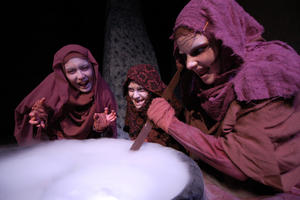
Double Double Toil and Trouble...
Arbron / Foter / CC BY

Most of the stories we recognise as “classic literature” do this. Shakespeare has murder and walking spirits and Birnam Wood coming to Dunsinane, but he also has “Tomorrow and tomorrow and tomorrow” and “Out, damned spot!” Dickens, Jane Austen, Mark Twain, most of the authors whose names everyone recognises tell two stories at once: the story of the outward events, and the story of the significance of those events.

By the significance of the events I don’t just mean their significance to the characters, though that is how we encounter it, through the characters’ eyes. The authors who are best at this manage to make the characters’ thoughts, reactions and emotions point beyond them to something more universal about being human.

For example, the story “Judgement Night” in the collection of the same name is about the fall of a galactic empire. However, it’s also about the heir to that empire, and her close brush with a love affair, and how her training as an amazon warrior makes her reject the emotional and relational side of life, and how that influences the empire’s fall. And that, in turn, is about masculinity and femininity, relationship and connection, competition and conflict, love and death. It’s all woven together. If you told just the story of the fall of the empire, it would work as a story by itself, but it wouldn’t have the richness and depth of the story that Moore does tell.

How I’m Applying This

If I look at someone else’s craft, it’s at least partly to improve my own (that’s a big part of why I write reviews).

There’s a writing concept called “scene and sequel” that Jim Butcher describes very well. In this context, a “scene” is what I’ve been calling the outward story: some things happen. A “sequel” is where the characters reflect on it and make it part of their internal stories (and hopefully the greater, more universal story).

My first Gryphon Clerks book, Realmgolds, has lost some readers because they felt that I didn’t do enough of the internal story sometimes. Other readers don’t seem bothered by it; perhaps it’s just that they’re already enough like the characters (and me) that they get what I was going for without my spelling it out, that they naturally understand how a character like that would feel. However, if I’m to improve as a writer and satisfy more readers, I need to take that criticism on.

When I was writing Hope and the Clever Man, I had a scene in it where two of the characters get caught up in a riot. Bearing in mind the lessons I’d learned, I added a couple of sentences of sequel to the end of it, in which the characters said something like, “I’ve never been so frightened in my life!” “Me either.”

Starting to deepen your stories can be that simple: taking a moment to show the reader what the events the character has just experienced mean to them.

Jan 21

Short Story Challenge begins

Something new today. I’ve decided to do a Short Story Challenge this year, which works as follows:

  1. I read and analyse a classic short story each month.
  2. I take what I learned and write a short story of my own.
  3. I submit it to magazines and anthologies until it sells, or until I run out of markets.
  4. Once the rights revert, I publish it on Amazon, either alone or as part of a collection, and/or make it one of the membership bonuses for my mailing list.

Several people I know on Google+ are joining me (some of them are doing slightly different versions), and you can follow along with the hashtag #shortstorychallenge.

I’m working, at least initially, from the Oxford Book of Fantasy Stories, selected by Tom Shippey. It’s a collection I own, I’ve read it before, and I know it has a lot of good stories in it, drawn from just over a century of fantasy literature (1888-1992).

I’m not planning to analyse every story in it, because I know I wouldn’t follow through on that. Besides, I only need a dozen, and I want to throw some SF stories in later on as well (probably from the companion Oxford Book of Science Fiction Stories, also selected by Shippey, and which I also own). I may look at a detective story or two – my wife has about 30 mystery anthologies, including a couple of Oxford ones that she says are good – and possibly some mainstream short fiction, of which I also have a couple of collections. It’s generally good to read outside your genre. It can freshen things up.

Here’s my first analysis, then. It happens to be of a story that’s freely available on the web: Lord Dunsany’s “The Fortress Unvanquishable, Save for Sacnoth“. I’ll analyse it under a number of headings, which I’m making up as I go along, and italicise the things I take as lessons. Future analyses may differ in approach. In fact, that’s highly likely.

Subgenre: Somewhere between Sword and Sorcery and Weird Tales. The events are S&S, the tone is Weird, and the combination works well. Crossing a couple of subgenres can have the effect of adding their strengths together.

Type of story: The plot has a strong Adventure core, but it’s not just an adventure. It’s also a Creepy Mood/Bizarre Experience story, like the ones that Lovecraft and co. wrote (going back at least to Poe). It has a Switch-up at the end, when the narrator questions whether it’s an Hallucination or even a complete False Legend. This kind of category questioning is part of the Weird Tales genre, I think, and contributes to the genre’s sense of confusion and fear.

Why the story works: It works more because of the atmosphere, the language and the tone than because of the plot, which is straightforward, with a minimal amount of tension in it (see analysis below). The adventure part would have made a decent story, perhaps a bit disappointing because the protagonist wins too easily. Those additional aspects make a great one. If you sizzle loud enough, you may not need as much sausage.

Language Elements: The names are the first thing to notice. The story itself is named after the fortress in it: The Fortress Unvanquishable, Save for Sacnoth. Even its door has a wonderful name: The Porte Resonant, the Way of Egress for War. Then there are the names of the other places, people, and enemies: the town of Allathurion, its lord Lorendiac, and his son Leothric (the first two sound more-or-less Norman French, the third Saxon, and all of them Arthurian); the dragons Tharagavverug, Thok, Lunk, and Wong Bongerok, whose resonant, clanking names reflect their metallic nature; the evil magician Gaznak, who sounds like a Tolkien orc;  The Land Where No Man Goeth. Take the opportunity that names provide to evoke atmosphere.

Then there are the descriptions. “Then Leothric advanced towards a door, and it was mightier than the marble quarry, Sacremona, from which of old men cut enormous slabs to build the Abbey of the Holy Tears. Day after day they wrenched out the very ribs of the hill until the Abbey was builded, and it was more beautiful than anything in stone. Then the priests blessed Sacremona, and it had rest, and no more stone was ever taken from it to build the houses of men. And the hill stood looking southwards lonely in the sunlight, defaced by that mighty scar. So vast was the door of steel.” That kind of description is hard to pull off, comparing something mythical to something else mythical that you have to explain, but if you can do it, you can convey a sense of a world that extends beyond the edge of this story; that’s being shot on location, not in a sound stage. Give the audience something that only appears in the corner of their eye to make the world more real.

A number of the descriptions of the evil things mention Satan. This not only gives a context (Christianity) but also ties them together through the repetition.
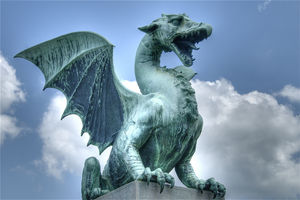
Dragon
wili_hybrid / Foter.com / CC BY-NC

The whole story uses an “elevated” and pseudo-antique style, the kind of style William Morris pioneered (following Spenser’s Faerie Queene): “unvanquishable” rather than “unconquerable” or even “impregnable”; “save for” rather than “except for”. This is incredibly hard to pull off (judging from the number of people who fail at it). You need a very large vocabulary and a good ear. All too many writers who attempt it have a much smaller vocabulary than they think they do, so they use the wrong word and make themselves look like idiots, and are prone to dropping modern colloquialisms into the middle of the high-flown prose at intervals and completely spoiling the effect. Dunsany has the linguistic chops to make it work. He knew what he was doing, and he could probably have explained it if he had to. Unless you can explain how and why this works, don’t try it.

Plot: Let’s attempt to apply the Seven-Point Story Structure and see where we get to.

Hook: The village by the dark forest full of fae is peaceful (paragraph 1). A little… too peaceful, if you know what I mean. Already, we’re waiting for the other shoe to drop. Hint at trouble as early as you can.

Plot Turn 1: The village becomes troubled by evil dreams (paragraph 2). There we go. Don’t hold off too long on the plot turn.

Pinch 1: The magician can’t defeat them with his best spell. (There’s actually a brief try-fail cycle here, by a minor character, the magician, who doesn’t reappear later, and the protagonist isn’t even introduced until it’s over.) The protagonist doesn’t have to do everything.

This sequence also does a lot to establish both the tone and the world: there is magic, there’s a culture that crosses various kinds of landscape containing camels, elephants and whales, even a village magician commands great power. Make the minor details work to establish world and tone.

Midpoint: Leothric steps up and volunteers to go and defeat the dragon-crocodile Tharagavverug in order to get the sword Sacnoth, so that he can defeat the sender of evil dreams. We have a sub-quest. Arguably, the whole sub-quest, in which he must demonstrate tenacity and courage and therefore his worthiness for the main quest, is part of the midpoint. The points can be extended sequences, not just moments; the midpoint is a demonstration of fitness to be the hero, not just a decision.

Pinch 2: Leothric fights his way into the Fortress Unvanquishable, Save for Sacnoth. This is a kind of try-fail cycle, the kind that looks like success. He keeps achieving tasks (break down the door; scare off the camel-riders; get past the spider; pass through the hall of princes and queens; resist the temptation of the dream-women; cross the abyss; fight the dragon; fight the other, more dangerous dragon), but none of them are the task he wants to achieve: fighting and defeating Gaznak. In his talks on the Seven Points, Dan Wells alludes to the example of The Princess Bride, where the Man in Black’s contests with Inigo, Fezzik and the Sicilian, and the encounters in the Fire Swamp, are “try-fail” cycles. He wins, he progresses, but he doesn’t yet achieve his ultimate objective: to escape to his ship with Buttercup. Try-fail cycles can involve the protagonist winning.

Leothric doesn’t have any serious trouble with any of these obstacles, yet the story remains interesting, because they’re so beautifully described and everything is so evocative. This is similar to Dunsany’s models, the Arthurian quests (Gawain and the Green Knight, for example, which also gets echoed later with the detachable head). Success against opposition, even easy success, doesn’t have to be boring, as long as the opposition is interesting and the success isn’t instantaneous.

Plot turn 2: Leothric finally confronts Gaznak, and just when it looks like he will lose (because Gaznak’s sword can destroy Leothric’s armour, but not vice versa, and Gaznak’s detachable head trick prevents Leothric from beheading him), he figures out that Gaznak has another point of vulnerability: his wrist. This has been set up in advance, so it doesn’t feel like it comes out of nowhere, and in exploiting it he adds intelligence to his already-demonstrated virtues of courage and tenacity. Set up the solution, even if only half a dozen paragraphs before. Have the hero snatch victory from the jaws of defeat. It’s never too late to have the hero show another quality that’s consistent with his character.

Resolution: The evil dissipates, Leothric returns home and the village is again at peace. Return to status quo ante is an acceptable resolution; the hero has changed, but the world may be back to how it was. 

After the resolution comes the little twisty doubty thing in the last four paragraphs. If anything, this makes the story more of a legend, claims for it the status of a traditional tale rather than a newly-made-up story, as well as raising the epistemological question of what is true, what is real, and how we know. Those are questions academics ask more often than ordinary people, and perhaps they were preoccupations of earlier generations more than our own. It’s not necessarily something to imitate, but I think it works for this story.

So there’s my analysis. Now I need to write my story. I have a story in progress, but I’m not sure that the lessons I’ve learned here are directly applicable to it, so I may need to start another.

Jan 08

How to Weaken a Scene

This morning, someone in a writers’ community I belong to on Google+ posted a link to this Ars Technica article about how some of the changes in the Hobbit movies were necessary to strengthen the writing. (Obviously, both that article and this post contain spoilers for both book and movie, if you care about that, and in fact assume that you’re familiar with both.)

Now, even though I love The Hobbit dearly (it was one of my first fantasy reads, if not the first, and I’ve read it at least eight times), I agree with much of what the article says. There’s too much coincidence, luck and deus ex machina in the book. However, I think some of the changes made in the movie weaken the story rather than strengthening it.

Example: The spiders. Compare these two versions.

Book version: The dwarves and Bilbo, after many days of trekking through the forest, are out of provisions and almost out of hope. Bilbo climbs a tree to scout and falsely gets the impression that they are still far from their destination. In desperation, they disobey Beorn’s advice and leave the path, trying to reach the elvish feasts they can see in the distance, but the elves, who are isolationists, keep disappearing as soon as they come near. They get separated in the darkness and confusion.

Bilbo wakes up from sleep being tied up by a giant spider, and kills it by a desperate effort. He luckily guesses which direction the dwarves are in, puts on his magic ring, and sneaks quietly towards them (it’s been previously established that he’s good at sneaking quietly).

The dwarves have been captured by the spiders. Bilbo cleverly manipulates the spiders through taunts and thrown stones to get them away from the dwarves, though he only just escapes from being surrounded by them and sneaks again to get away. He then kills another spider which has stayed behind, and begins to free the dwarves (who are in a bad way from the spiders’ poison on top of their hunger and exhaustion). Before he can finish, the spiders come back, and they all have to fight. Bilbo cleverly draws them off again, and the dwarves make a desperate escape, having to fight repeatedly (with inadequate weapons) despite their weariness, hunger and the lingering effects of the spider poison. At a moment when it looks like the spiders will surround them and overwhelm them, Bilbo reappears and gives them the opportunity to escape. Bilbo fights so well and so determinedly, in fact, that the spiders eventually give them up as a bad job and go back to their nests.

The dwarves then realise that Thorin (their leader, and incidentally the only one with a decent weapon apart from Bilbo) has disappeared. He has been captured by the elves. The elves subsequently capture the rest of the dwarves as well, but Bilbo again uses the ring to escape and follows them.

Movie version: The well-supplied dwarves are having a bit of a frustrating time finding their way through the forest after what appears to be a few hours, so they send Bilbo up a tree to scout. He happily discovers that they’re close to their destination. When he gets back, though, the spiders capture everyone, including him. He wakes up for no particular reason, gets himself out of a thorough binding and kills the spider with no real difficulty, and the dwarves start doing the same with a variety of effective weapons. The spiders are, individually, low-level mooks and apparently not much of a threat, but there are a lot of them.

The fight goes on for a long time, killing spiders, killing spiders, killing spiders. Then we get elves ex machina who finish up the fight, drive the spiders off and capture the party, apart from Bilbo, who rings up and follows as per the book.

Wolf Spider Portrait
e_monk / Foter.com / CC BY-NC-SA

Yes, the book version uses a lucky guess (the direction in which the dwarves were), though it’s really more of an informed guess. But what gets established? Bilbo is resourceful, clever and brave. He can manipulate, sneak and fight. The dwarves’ situation starts out bad and gets worse, then improves thanks to the protagonist’s action, then gets worse again in a different way, and that cycle repeats several times. There’s a lot of desperation, for several different causes.

In the movie, all of this is lost. It’s flattened out to a straightforward fight in which Bilbo is, if anything, one of the weaker players. There’s no real escalation of tension, not much up-and-down movement of the tension graph at all, in fact, and most of the sources of tension (hunger, weariness, loss of hope, believing they are far from their destination, being poorly armed and weak from spider venom) are removed completely. The protagonist doesn’t solve the problem. We don’t get to see much increase in his abilities. He doesn’t show himself to be clever, resourceful or sneaky. The result is a bland bit of action with not much significance to the story or the characters, that isn’t even that exciting to watch.

Now, I didn’t write this just to sling mud at Peter Jackson and his writers. I think there’s something to be learned here about writing.

Turn the process around. If you have a bland bit of action with not much significance to the story or characters, here’s how you can punch it up.

1. Make the characters more desperate and/or weaker, so that the outcome is more in doubt. They’re out of supplies, they have inadequate weapons, they’re poisoned, they’re lost, they don’t know how far they have to go but it seems further than they can go. When desperate, weak characters triumph after a hard fight, it’s more exciting than if strong, competent characters triumph after an easy fight.

2. Don’t just write it as “they fight a thing, they fight another thing the same as the first thing, they fight yet another thing”. Write a series of problems from which the characters have to escape: One-on-one conflict. Drawing off the spiders. Spiders nearly surround Bilbo. He gets away and starts to free the dwarves, but the spiders come back before he’s finished. Spiders nearly surround the dwarves, Bilbo rushes in from the side and breaks through.

I watched an excellent example of this the other day: the truck chase sequence in Raiders of the Lost Ark. It’s a thrilling sequence because it’s not just solving the same problem over and over, it’s solving a series of different problems in different ways on the way to an overall goal (escape with the Ark). Indiana Jones must pursue the truck on horseback, jump on, force his way in, overcome the Nazis inside, then he gets attacked by other Nazis who climb forward from the back of the truck (antagonists can struggle and be brave and resourceful too), he’s forced out, he climbs under the truck and is dragged behind, gets back up and in control of the truck again, has to contend with the other vehicles in the convoy (which he gets rid of by several different tactics), hides the truck in the village… It has variety, and every time he solves a problem he gets a new, and different, problem. We get a series of small releases of tension as he solves each problem, but the overall tension continues until the end of the sequence.

3. This deserves to be its own point: Give a variety of problems a variety of solutions. Not just “stab a spider, stab another spider, stab a third spider”.

4. Take the opportunity for character development. If Bilbo is going to encounter Smaug with any expectation of success, he needs to be clever, resourceful and sneaky. This scene (in the book) establishes that he is becoming all of those things.

5. Have the protagonist solve the problem. Tolkien is as guilty of violating this as anyone, but not in the spider sequence. It’s not fatal to have your protagonist rescued occasionally, but if it becomes a habit, they’re not much of a protagonist.

6. Have the problem be more than just “do they win the fight?”. Most of the fights in The Desolation of Smaug have no higher, greater or other stakes than “do the heroes win this fight?” Those are not very interesting stakes, especially when you’re pretty sure the answer is going to be “yes”. Will the heroes be eaten by the spiders? Will they find their way out of the forest? Will they starve? Where is their leader, and how can he escape? Can Bilbo continue to conceal his possession of the ring? All of these things are at stake in the book version, and they lead into and out of the fight, meaning that the fight is hard to remove as a story element. The movie version of the fight (and most of the other fights in the movie) could be completely removed as a story element and nothing else would need to be rewritten. That’s a sign of weak writing, and a scene that isn’t necessary because it doesn’t do anything except present a (rather dull) spectacle.

I’ll close with a link to another article: Why You Should Never Write Action Scenes for Your Blockbuster Movie. It’s excellent writing advice in general, and the summary version is: Don’t write action scenes. Write suspense scenes that require action to resolve.

Oct 21

How to Write a Sequel, or Happily Never After

I’m writing a series. I hope it’s a long series. I hope I get to work on it for 40 years or more (I’m 46). Whether I do or not, I have one book out, two more with my editor and beta readers (those two books are closely linked), a third that I’m revising and a list of ideas in various states of development. Barring the usual things that you bar over the next several years, we’re looking at at least half a dozen books that I can see from here.

Writing a series is different from writing standalone novels, which is what I’ve done previously. I’m taking the Terry Pratchett approach to series – a number of more-or-less interlinked stories in the same setting, with overlapping characters, places and events – rather than the typical epic fantasy one-enormous-story approach. (I recently discovered that Steven Donaldson has published the tenth, and final, Thomas Covenant novel. I started reading those when I was at high school. I don’t have kids, but if I did they would probably be about the age I was then, or older, so it’s taken him a generation to finish his story. George R.R. Martin is still going, with no end in sight.)

Even if you take the Terry Pratchett approach, even if you don’t follow the same characters all the time and don’t have one big overarching plot arc, you’ll still want to tie books together. The approach I’ve stumbled upon is what I call Happily Never After.

That’s not as negative as it sounds. It’s based on the endings to fairy stories, of course: “And the Prince married the Princess, and they lived happily ever after.” The wedding in a romance, or the defeat of the main boss in an adventure, draws a big line under the story and says, “Finished now.”

If you’re writing a series like mine, though, that moves from story to story, nothing is a final ending. And, in fact, each ending contains the seeds of the next beginning – because every time your characters achieve something, that’s another thing that can cause problems for them (or someone else) later on.

Endless love
Millzero Photography / Foter / CC BY-SA

I base this, like so many things, on real life. You got the promotion you were striving for? Great. But now you have more work, more responsibility, a new set of problems. You finally asked that person out? Fantastic! Welcome to your awkward first date. You’re married? Terrific! Whole new set of problems there*. You’ve killed the main boss? Go you! Let the revisionist history/battles to fill the power vacuum/revenge attacks/resistance to the occupation begin.

We don’t need to look far in our own life or in real-world politics to see that bringing something to a conclusion often just means substituting one set of problems for another. Our childhood tales tell us that when we kill the evil guy and/or marry the prince/princess our troubles are over, but it’s just not so. The “all our problems will go away if we just kill this one evil guy” narrative, in particular, has proven hideously destructive (and wildly inaccurate) within the past decade.

When I got to the end of Realmgolds, the first book in the Gryphon Clerks series, I made a list of 20 problems that the resolution of that book had either created or intensified. They’re enough to keep me writing for years.

The two linked books that are currently in edit/beta? The hopeful ending of the first sets up the opening problem of the second so neatly, it’s as if I planned it that way.

I didn’t. I didn’t need to. Every solution potentially contains the seeds of the next problem, even if you don’t have an overarching plot. Even if you’re working within the same book, rather than a series, in fact. (Note to self: Do that more.)

* I should mention I’m happily married. Just because you have a set of problems/challenges, doesn’t mean you’re miserable.

Sep 17

Three Points of View of a Flat

I’m working on two books at the moment, as I mentioned in my last post, both of them featuring the brilliant young mage Hope. In the second one particularly, I’m playing with point of view, telling the story through several different people’s eyes.

As it happens, three of those people are shown seeing the same thing (a house) for the first time in the course of the two books. It’s a classic writing exercise to reveal character through point of view by describing the same thing through different sets of eyes, and here I’ve done that writing exercise in my actual novels.

Let’s hear from Hope herself first. She’s the daughter of upper servants in a remote part of the realm who has come to the mainland to study magic, and she and her friend Briar are looking for a place to live. As an energy mage with a special interest in light, she mostly notices things like the colour of the paint.

The old house had been converted into several flats when the neighbourhood lost its cachet and the well-off families moved elsewhere. Built of brick, probably, Hope thought, but surfaced with plaster so you couldn’t really tell. There were no cracks, the steps were clean, and if the exterior paint was not fresh it was at least clean too, and a cheerful yellow.  Someone had made some attempt at a garden in the front, and it was free of rubbish and the shrubs were in good health, if a little shaggy.

Now let’s hear what Patient thinks. He’s a woodcarver.

He reached the house without further incident as the light faded from the sky. He hadn’t been there before, and was impressed with the tidy exterior. An older house, but well cared for, and some nice jigsaw work on the bargeboards….

He ascended the old-fashioned staircase — all dark-stained wood with some very decent banister carving, though it could do with a touch-up on the stain — turned right and knocked on the door.

And here’s Rosie. Rosie’s parents are wealthy, and she’s lived a sheltered life. She’s considering moving out on her own, though.

Promptly at the twelfth deep bell (she had inherited her respect for other people’s time from her father), Rosie fetched up in front of a smaller, plainer house than she had imagined Mage Hope living in. Of course, the mage was from a servant family, so she didn’t have inherited money, she’d made it all herself. That presumably made a difference. Which would mean that this was the kind of house Rosie could afford to live in, if it wasn’t for her parents. Hmm.

Same house. Three different viewpoints. Three different voices.

I love doing this sort of thing, having developed a taste for different character voices by reading my earlier book, City of Masks, aloud in order to put it on Podiobooks.com. It only takes a few little touches to give characters distinctive voices, and I think it provides the reader with a richer experience.

Jul 30

Freshness and Familiarity: Finding the Goldilocks Zone

OK, disclaimers upfront:

  1. Everything I’m going to say in this post is about my own taste.
  2. If your taste is different (entirely likely), that’s fine with me.
  3. Your taste being different doesn’t invalidate what I say about my own preferences, or, of course, vice versa.
  4. I nevertheless doubt that I’m the only one who feels this way.

Having got that out of the way, I want to talk about a spectrum in fiction writing that I’m going to call “freshness” versus “familiarity”. “Freshness” implies that the author is doing something new, seldom or never seen before, while “familiarity” means that they’re using elements (both genre elements and story elements) that have been around for a while.

Every book is somewhere on this spectrum. Finnegan’s Wake is probably about as far as you can go towards the freshness end without degenerating into random word-salad (and even that references earlier literature), and up the other end we have, I don’t know, fanfiction that’s just a rewriting of a scene in canon.

Now, straight away I’ve dropped an implication that freshness is better, and I don’t necessarily think that. I picked Finnegan’s Wake up once, and quickly concluded that I didn’t want to work that hard and probably wasn’t that smart, and put it down again. Certainly, though, freshness is harder.

Goldilocks
violscraper / Foter / CC BY-NC

For me, the Goldilocks Zone on the freshness-familiarity spectrum is a broad one. I can enjoy a book like Charles Stross’s Halting State, for example, written in second person, or one of his posthuman novels like Glasshouse. I can also enjoy a book that’s very nearly pure vanilla D&D-style fantasy, or off-the-shelf space opera, as long as other aspects of the book (the characters, the writing, the plot) are well done – and have some freshness to them.

There is, though, such a thing as too much, and that applies both to freshness and to familiarity. I abandoned Walter Jon Williams’ Aristoi, for example, 25% of the way through, because I didn’t have a clue what was going on (and also didn’t care about the characters). I didn’t get past the sample for Hannu Rajaniemi’s The Quantum Thief, for a similar reason, even though I love heist novels. When too much is unfamiliar, I become disoriented and it’s easy for the book to lose my attention.

On the other hand, if I come across an epic fantasy in which the blacksmith’s boy loses his parents in the first chapter (when cruel, heartless, evil people destroy their village) and joins up with quirky and assorted companions in a quest for an artifact which, as the Chosen One, he is destined to wield against the Dark Lord, I pass it by. I’ve already read that story, and when I read it before it was probably better written.

There’s nothing inherently wrong with tropes, whether genre tropes or story tropes. I’m highly trope-tolerant. Oh, regardless of how much death and destruction is raining down, all of the core characters always survive, shrugging off significant injuries in insignificant amounts of time? OK, it’s one of those stories. I can live with that. (Though some tropes are easier to tolerate than others, and the others are usually the ones that allow the writer to take shortcuts in character development and plotting.)

Where I start to have a problem is if the whole thing, or almost the whole thing, is constructed out of tropes, as if someone had built a character, plot and setting generator out of the TV Tropes website and run it, then filled in the resulting outline with poorly-written prose. I think of those as paint-by-numbers books. There’s too much familiarity.

Sadly, a great many indie writers look out on the vast ocean of possibilities represented by the indie publishing revolution, in which they no longer have to write what the big publishers are buying in order to have a chance to reach an audience, but can create something genuinely new and fresh… and then they write another vampire romance with a whiny, annoying teenage heroine who’s simultaneously the most awesome person ever and too stupid to live.

Freshness is hard, yes. And familiarity is important. But if you want to succeed with me, and readers like me, you’re going to need to strike for the Goldilocks Zone.